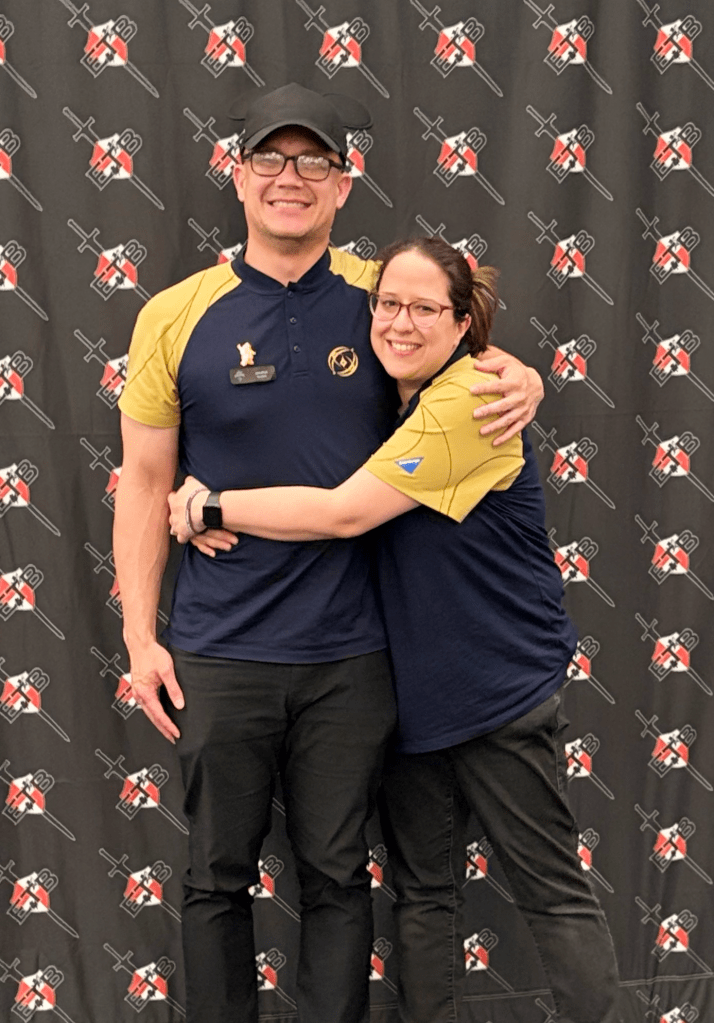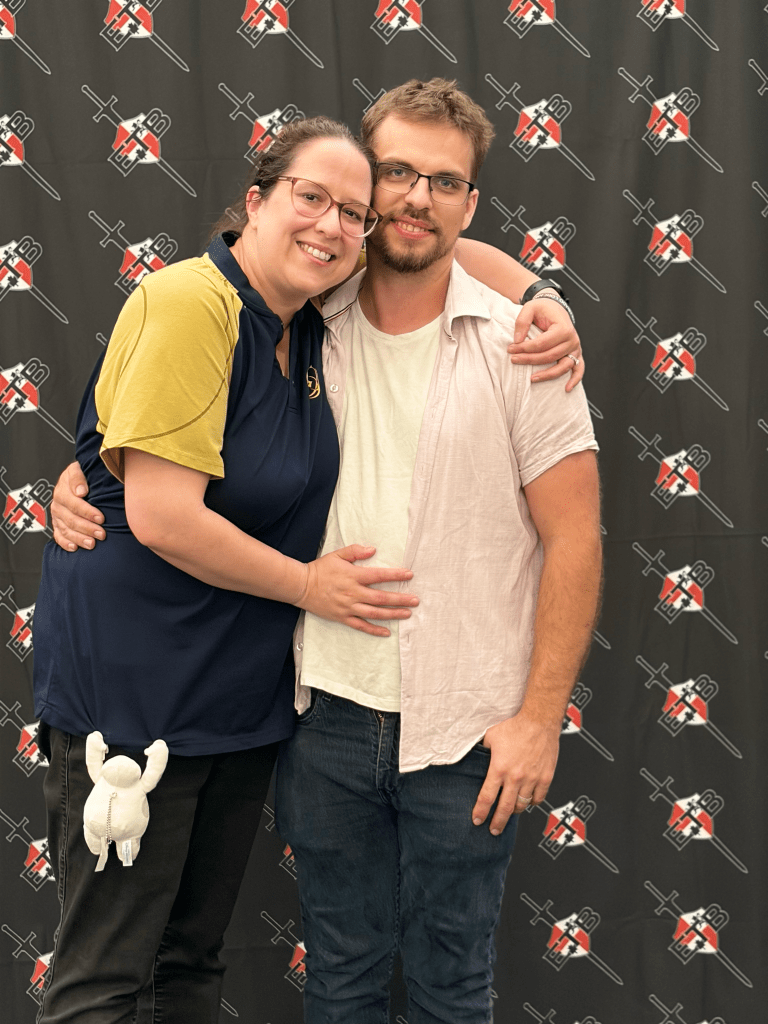
• Alex (Arcas) was the lead lore guide of the ETB 15k CCQ that just happened this past weekend (May 30th-31st) in Oakville, ON Canada. She did an amazing job and has graciously allowed me to host her tournament report here… so without further ado…

    Enter The Battlefield 15K CCQ Tournament Report

    by Alex (Arcas) Symington

    May 30–31, 2026 | Oakville, ON Canada
    Lead Lore Guide: Alex (Arcas) Symington
    Part of My World

    I have officially survived my first CCQ as Lead Lore Guide.

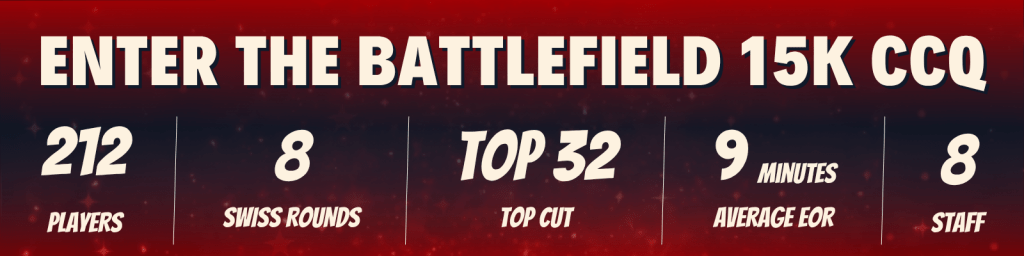
    Not my first time head judging, but absolutely my first time head judging something at this scale. Smaller events are one thing. A 212-player CCQ with 8 rounds of Swiss, a Top 32 cut on Day 2, coverage, side events, a full judge team, and all the tiny moving pieces that come with a major weekend is very much another thing.

    And honestly?

    I am really proud of this one.

    Be Our Guest, All 212 of You
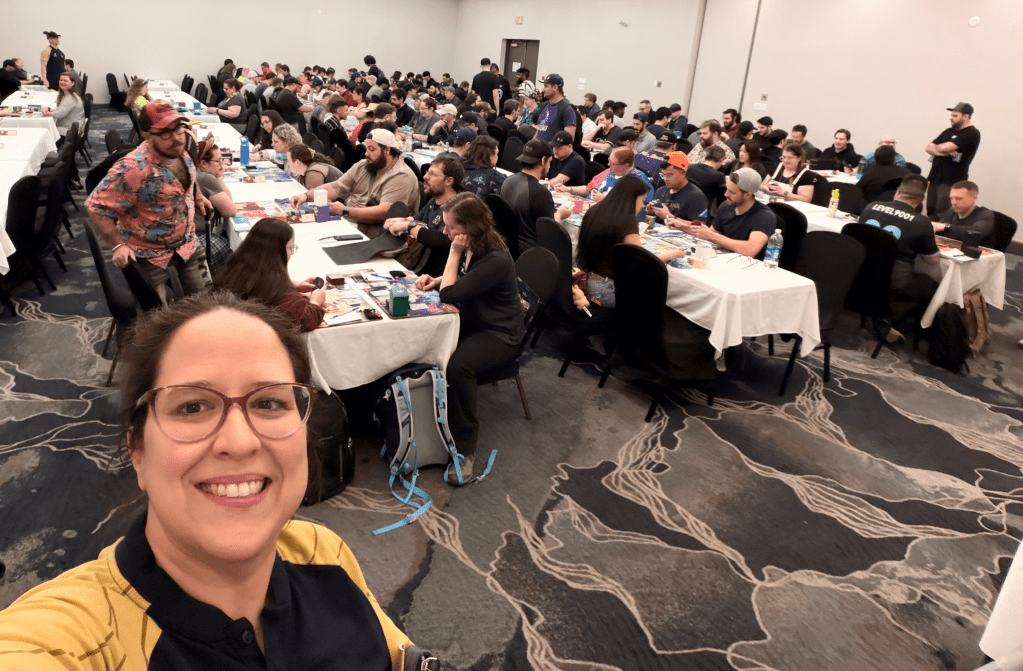
    Going into the weekend, I knew the event was going to ask a lot of the judge team.

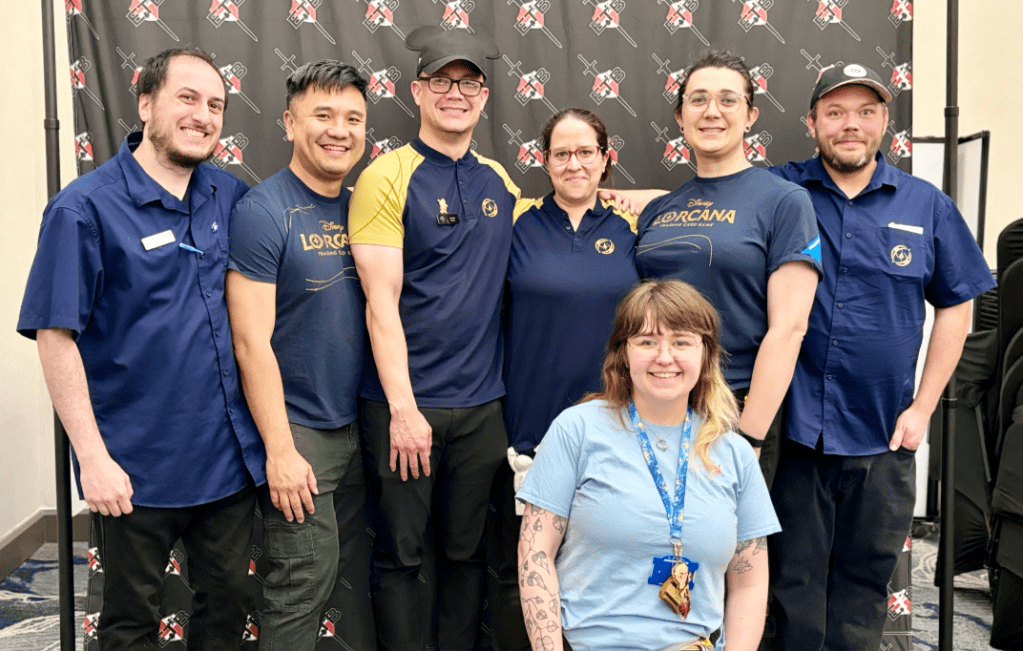
    We had 1 Lead Lore Guide, 1 Appeals Judge, 4 Lore Guides on Saturday, 5 Lore Guides on Sunday, and 1 scorekeeper.

    That sounds like a lot until you are looking at 212 players, long rows of tables, a stream area, side events, deck checks, end-of-round procedures, questions coming from every direction, and a judge Discord that suddenly becomes your second brain (Shoutout Lorecana Rulebook Hub).

    The part I will remember most is how supported I felt.
    This weekend was not “Alex runs a CCQ.”

    It was a full judge team showing up, adapting, solving problems, and making the event better as we went.

    Judge Takeaway: Scale is not just about player count. It is about how many situations are demanding judge attention at the same time. The right team structure matters.

    You’ve Got a Friend in the Judge Team

    I have spent a lot of time judging events where I am used to just handling everything myself, especially anything around 32 players. So on Day 2, having another judge assigned to work directly with me for Top 32 felt weird at first.

    My instinct was very much, “No no, I can do this.”

    But that was not the point.
    The point was player experience.

    If I am the only judge actively covering those matches, players do not really have a clean appeal path. Pairing another judge with me was the correct call, even if my brain had to fight the little goblin that says, “You should be able to do everything alone.”

    Turns out, good event structure is not about proving you can carry everything.

    It is about building the right support around the players.

    Judge Takeaway: Appeals structure should not be theoretical. Players need a real, accessible path to appeal, especially in high-stakes rounds.
    THE REASON THE EVENT WENT SO WELL

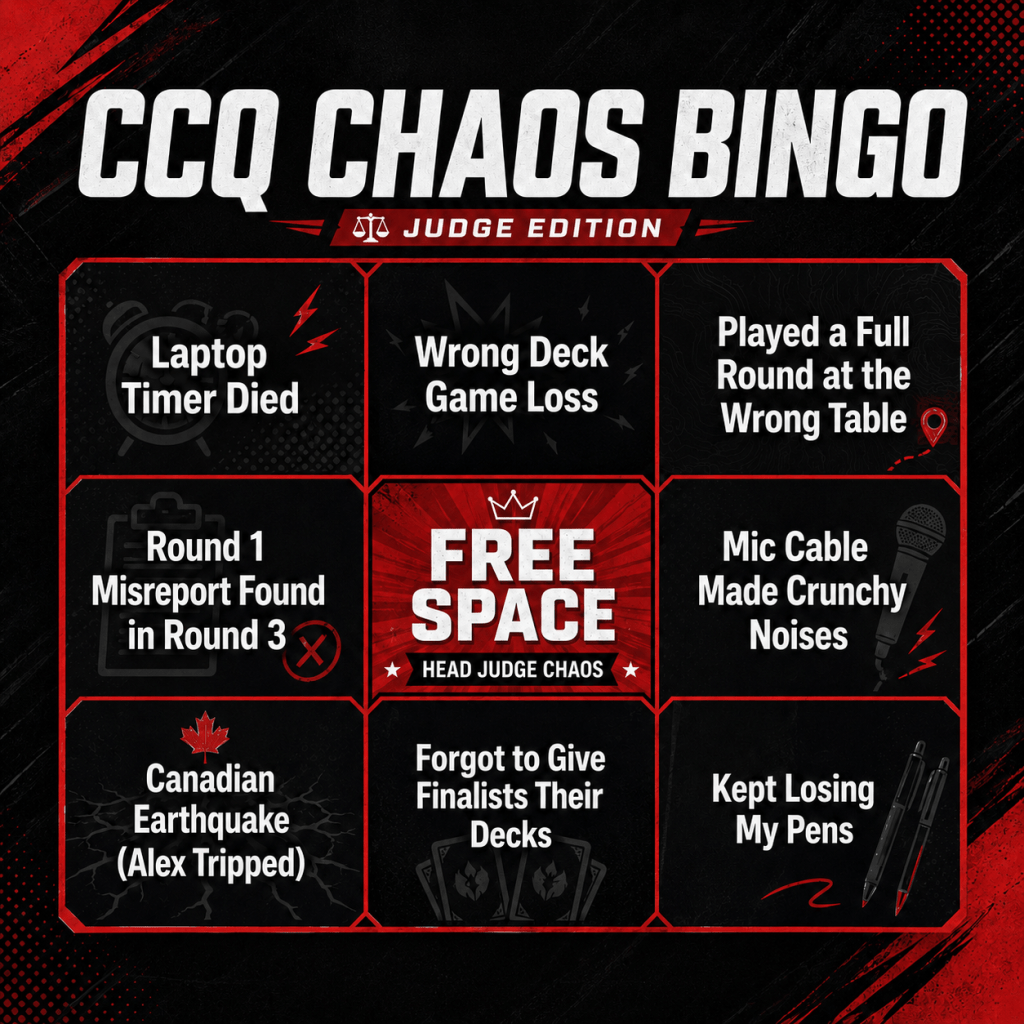
    The Weekend Bingo Card Filled Itself

    Every large event has its own little chaos bingo card, and this weekend came prepared.

    None of these are the kind of things you want to happen, but they are exactly the kind of situations that test whether your event team can stay calm, communicate clearly, and fix the problem in front of them.

    We had technical hiccups. We had player movement issues. We had wrong-table problems. We had a round result entered later than it should have been. We had finalists who, shockingly, needed their decks to play the finals.

    The important part is that the team handled them, the event kept moving, and every single hiccup gave me something to carry into the next event.

    For future events, I want more formal checklists around key transition points: start of round, end of round, top cut setup, deck movement, feature match movement, and finals preparation. Not because anyone failed, but because major events are full of small moments where a checklist protects everyone from brain fatigue.

    Judge Takeaway: Big event mistakes are rarely one giant failure. They are usually tiny process gaps that show up when everyone is tired. Checklists are boring until they save you.

    Also, finals players need their decks.
    Groundbreaking tournament operations insight from your Head Judge.

    I Can Show You the Stream

    We also had a feature table judge call that did not go the way it should have, and the virtual audience quickly filled in the blanks without the full context.

    The real situation was much less dramatic than it looked from the outside: the player had only started playing their deck a few weeks earlier.

    A good reminder from that one:

    Stream calls are not just rulings.

    They are public rulings.

    The judge call, the body language, the explanation, the casters’ reaction, and the chat’s reaction all become part of the player experience. That does not mean we treat feature match  players differently, but it does mean we need to be extra aware of how quickly an unclear moment can turn into a story that is not accurate.

    For future streamed events, I want judges to be reminded that camera matches need calm presence, clear explanations, and quick escalation when something feels unclear. Not because the ruling changes, but because the audience does not have the same context the judge has at the table.

    Judge Takeaway: Stream rulings need the same policy foundation as any other ruling, but they require more awareness of communication, body language, and public perception.

    What Can I Say Except: It’s Dale
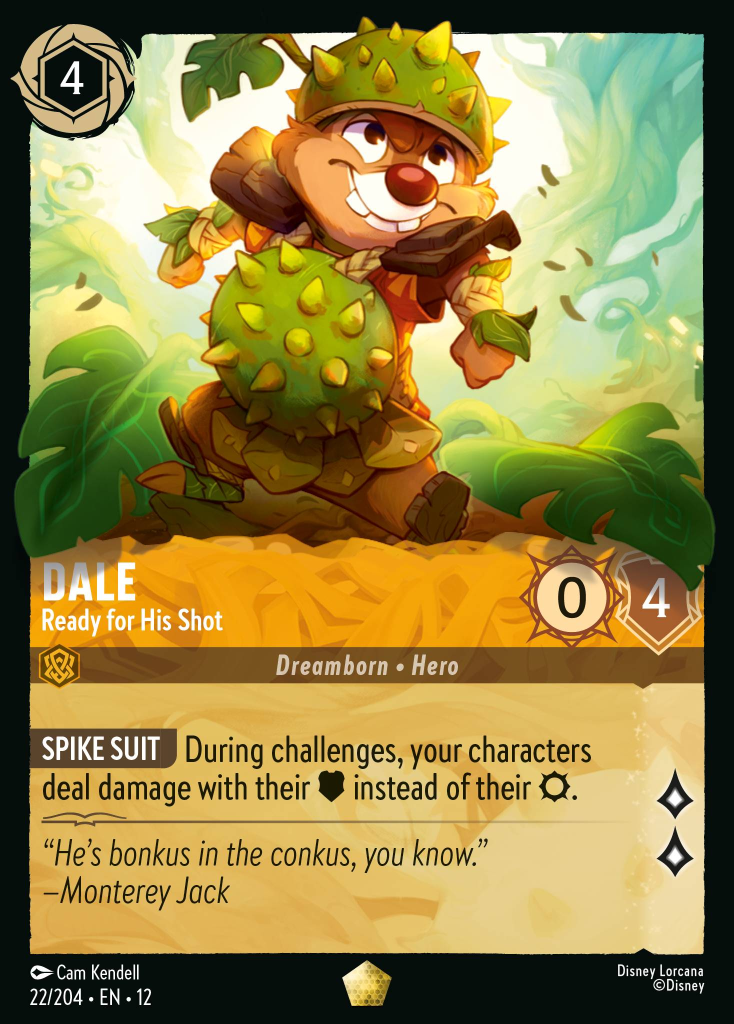
    Rules-wise, Dale ended up being one of the top calls of the weekend.

    Understanding how that card interacts came up repeatedly, and it was a good reminder that the “popular call of the weekend” is not always something obscure.

    Sometimes it is just the card people are playing a lot, and judges need to be aligned on it early.

    Dale became one of those cards where repeated questions made it clear that the judge team needed shared language and consistent handling. Once a card keeps coming up, it is worth pausing, aligning the team, and making sure everyone is giving the same answer.

    Judge Takeaway: Early pattern recognition matters. If the same card or interaction comes up multiple times, align the team before it becomes inconsistent.

    Unfortunate Investigations

    Outside of the main 15K event, we also had a side-event investigation. 

    I am keeping the details out of this report because that situation deserves the right context and documentation, but it was a clear reminder that even when the main event is the focus, side events also deserve real judge attention, clear communication, and proper escalation.

    Side events cannot just receive leftover coverage.

    They need a dedicated judge presence, a clear escalation path, and the same seriousness when something crosses into investigation territory.Judge Takeaway: Side events are still events. If players are competing, judges need coverage, communication, and escalation plans.

    Go the Distance, End of Round Edition

    Operationally, one of the things I am happiest with was end of round.

    Our average end-of-round time was 9 minutes.

    That is something I am genuinely proud of. End-of-round procedures can make or break the feel of a long tournament day. Clean, fast end-of-round procedures keep players moving, keep staff from drowning, and help the entire event feel more controlled.

    It was not magic.
    It was judge coverage, communication, scorekeeping, and everyone understanding what needed to happen before the round actually ended.

    A clean end of round starts before time is called. Judges need to know where they are watching, scorekeeping needs clean information, and the team needs to be ready to collapse the round quickly without creating confusion.Judge Takeaway: End of round is not a single moment. It is a process that starts before time is called.

    Under the Table Space

    The room itself was another learning point.

    Players did not have as much playing space as I would have liked on Day 1. Once players started leaving on Day 2, we were able to clear the hall briefly and separate the tables more.

    That immediately improved the room.

    It is one of those things that seems small until you are watching players try to manage decks, discard piles, lore trackers, bags, water bottles, and paperwork in a very tight space for eight rounds.

    Player comfort matters.

    Space matters.

    Table layout matters.

    Future Alex will be louder about this during setup, not after Round 1.

    Judge Takeaway: Table spacing is not just a comfort issue. It affects communication, board clarity, judge access, player stress, and the overall feel of the event..

    Be Prepared… or Let It Go
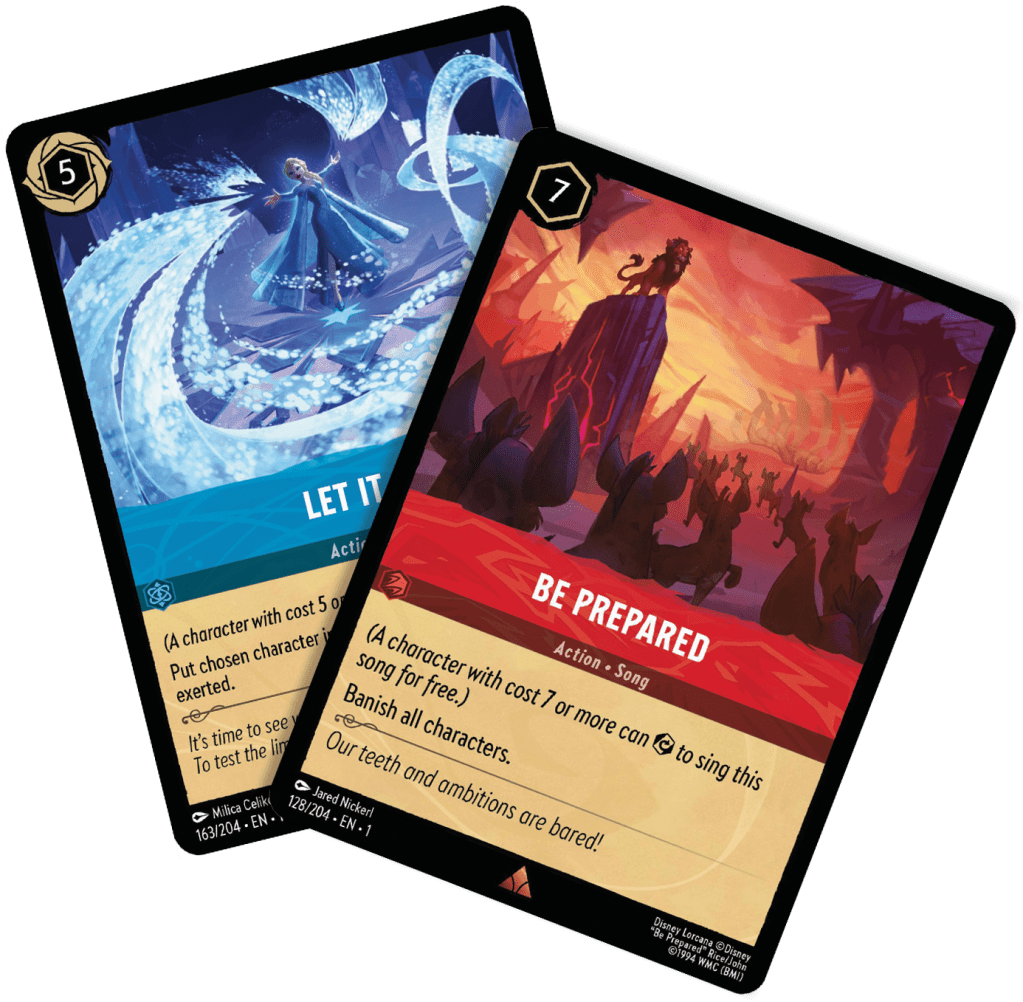
    We also used an anonymous voting system for a prize split decision in the 5K side event, which I always really like to do.

    The options were themed as “Be Prepared” for wanting to play it out and “Let It Go” for splitting.

    Cute? Yes.
    Functional? Also yes.

    Prize split conversations can put a lot of pressure on players, especially when they are tired, emotional, running up against time restraints, or sitting across from someone they do not want to disappoint.

    Sometimes players want to split because the day has gone long. Sometimes they have travel plans, work the next morning, family waiting, or they are simply out of energy after hours of competitive play. Those are real factors, and players should be able to make that choice without feeling pressured either way.

    Even when everyone is being respectful, there can still be an awkward social pressure to agree with the table.

    The anonymous voting system removes that pressure.

    It lets each player make their own decision privately, without needing to justify it, defend it, or worry about being “the person who made everyone play it out.” It also gives judges a clean process to follow and makes the final decision feel much more comfortable for everyone involved.

    It kept the process private, clean, and still very Disney Lorcana themed.

    I will absolutely be using this method again.

    Judge Takeaway: Anonymous voting protects player autonomy. If every player needs to agree, every player should be able to answer privately.

    One Jump Ahead? Not This Time

    Jon, my Appeals Judge, approached me before Top 32 and told me that he likes to sit at the finals table for his events.

    My first reaction was very much, “No, I need to keep moving.”

    That instinct makes sense. As Head Judge, it can feel like you need to constantly be in motion to be useful. Checking tables, checking staff, checking scorekeeping, checking the room, checking the 47 tiny fires that may or may not be starting.

    But then I realized he was right.

    For Top 32, my job was not to patrol the room like it was still Swiss.

    My job was to protect the integrity of the highest-stakes matches in the event.

    Sitting at those tables, being present, and being fully locked in was not me doing less. It was me choosing where my attention mattered most.

    I had a few people comment on how “locked in” I was at that table, and they were right. I was not looking around the room. I was not half-watching five things at once.

    I was watching the match in front of me.

    That matters.

    At that point in the tournament, one missed interaction, one unclear communication, one sloppy shortcut, or one tense player moment can have a huge impact. Being fully present gives players confidence that the match is being protected, that help is right there if needed, and that the event is taking their match seriously.

    It was a good lesson for me.

    Sometimes Head Judging means moving.

    Sometimes Head Judging means sitting down and not moving at all.

    Judge Takeaway: The Head Judge’s best location changes as the event changes. During Swiss, movement may matter most. During top cut, focused presence may matter more.

    Happily Ever After, but With More Paperwork

    What I am taking away from this weekend is not that everything went perfectly.

    It did not.

    No major event ever does.

    What I am taking away is that we handled the things that came up.

    We adjusted. We communicated. We escalated when we needed to. We fixed what we could fix in the moment. We learned from the things we could not fully fix.
    And, most importantly, the judge team cared.

    They cared about the players, the event, each other, and the experience we were creating.

    That is the part that sticks with me.

    For my first CCQ as Lead Lore Guide, I could not have asked for a better team or a better community to learn with. I walked into the weekend knowing I was capable but still carrying all the normal fear that comes with doing something this big for the first time.

    This weekend also made something click for me personally.

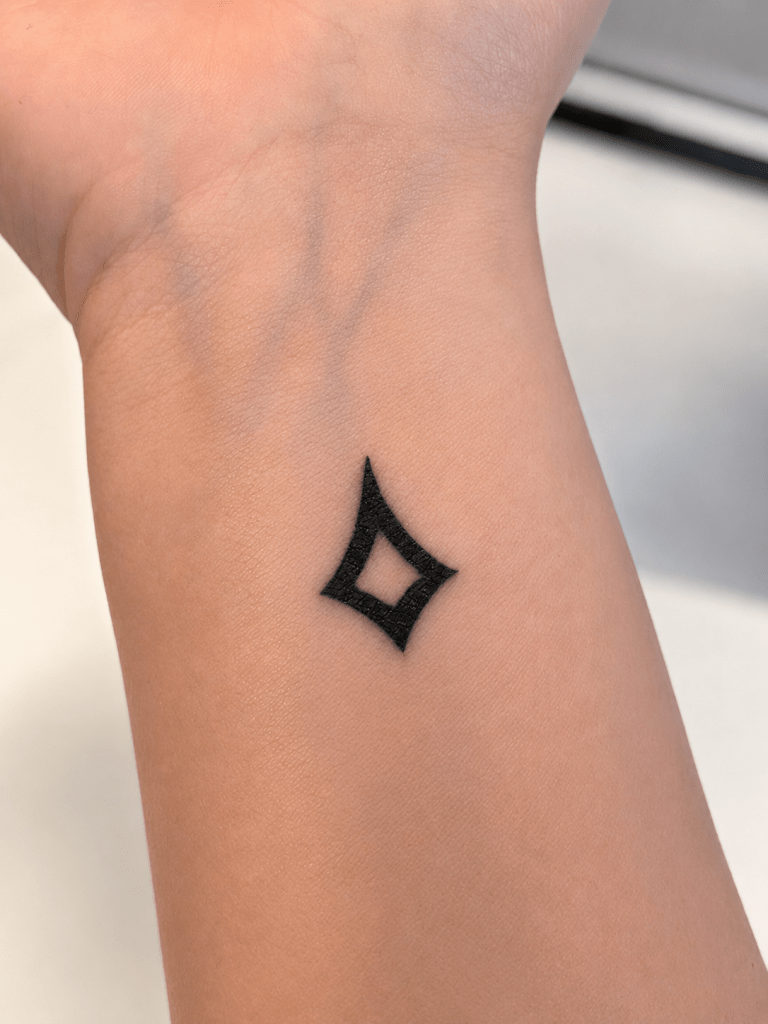
    I got a lore pip tattoo.

    And yes, it is because I love Disney Lorcana, but it is also more than that. It is a reminder of what this game and this community have helped me prove to myself.

    I can step into bigger rooms.
    I can lead bigger teams.
    I can handle pressure.
    I can make difficult  calls.
    I can learn in public.
    I can make mistakes, fix them, and keep going.
    I can be proud of myself without needing everything to be flawless first.
    So yes, it is a Disney Lorcana tattoo.

    But it is also a little permanent reminder that I earned my lore, too.

    My Poor Unfortunate Rolls

    Every event has its traditions, and one of mine is the dice count.

    At the end of every event I judge, I “adopt” the dice that get left behind and make their way to Lost & Found. I like to think of them as tiny abandoned math rocks just looking for a second chance.

    They are lovingly known as My Poor Unfortunate Rolls.

    Some judges collect stories. Some collect judge promos. Apparently, I collect the dice that players accidentally leave behind.

    So, as is tradition:

    Final Dice Count: 12 Poor Unfortunate Rolls successfully adopted from Lost & Found.

    Thank You

    A huge thank you to Enter The Battlefield for trusting me with this event, and to the judge team for showing up with care, patience, flexibility, and confidence all weekend.

    Thank you to Jon for being the support I needed before I even knew I needed it, to Niko for keeping scorekeeping steady, and to every floor judge who helped make the event feel controlled, welcoming, and well cared for.

    Thank you to the players for bringing the energy, the patience, the competitive spirit, and the community that makes Disney Lorcana feel special.

    And a very special thank you to my husband, who does not play Disney Lorcana, but still showed up, played, supported me, and spent the weekend beside me in a world that means so much to me.This weekend meant a lot to me.
    Not because it was perfect.
    Because it reminded me that I do not need everything to be perfect to be proud of what we built.
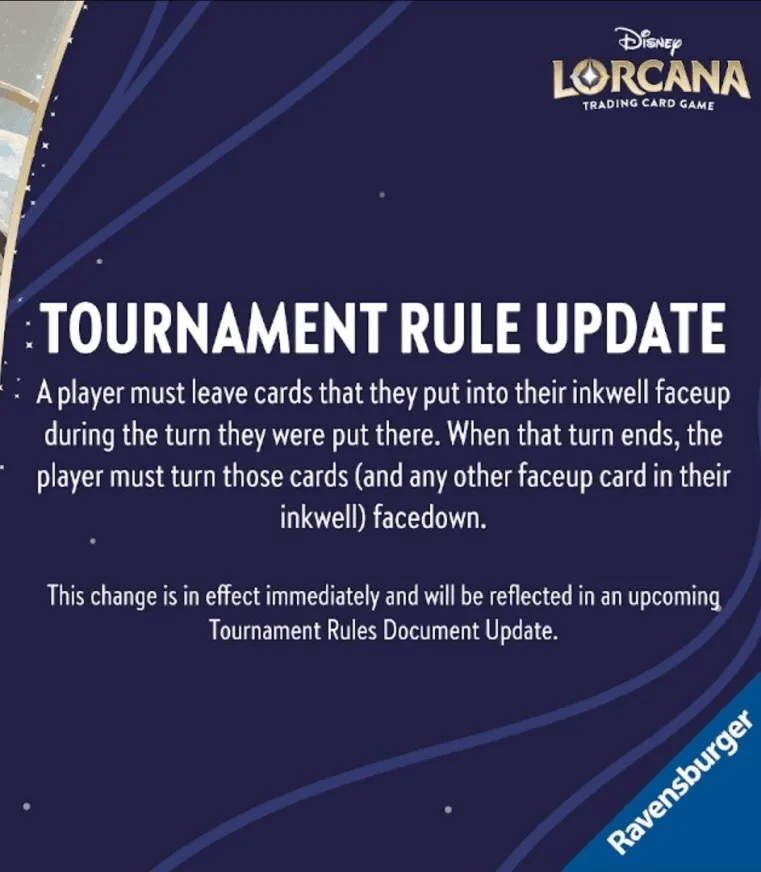
  • Today’s (May 14th, 2026) lorecast brought on an additional rule that will impact players during upcoming tournaments!

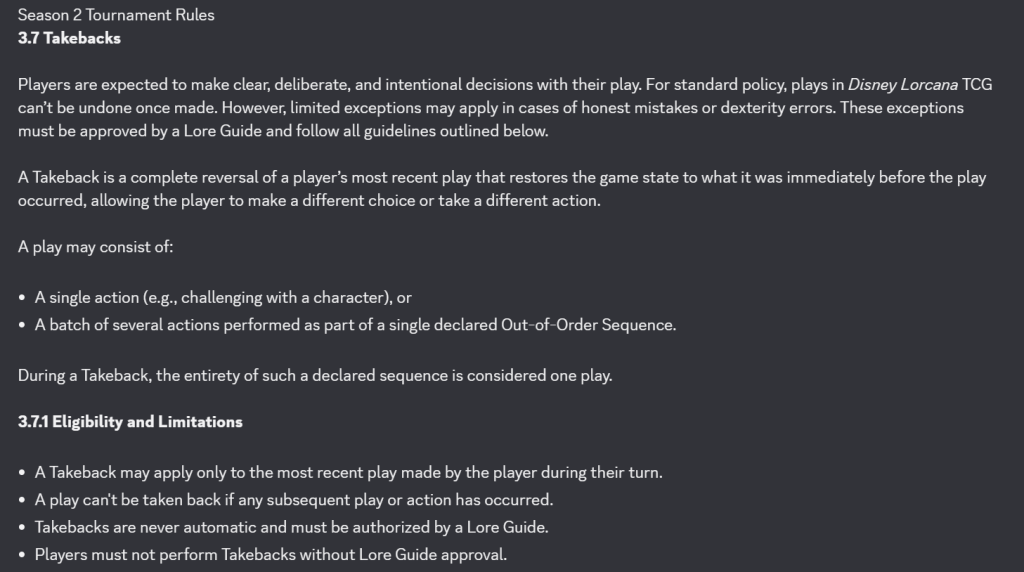
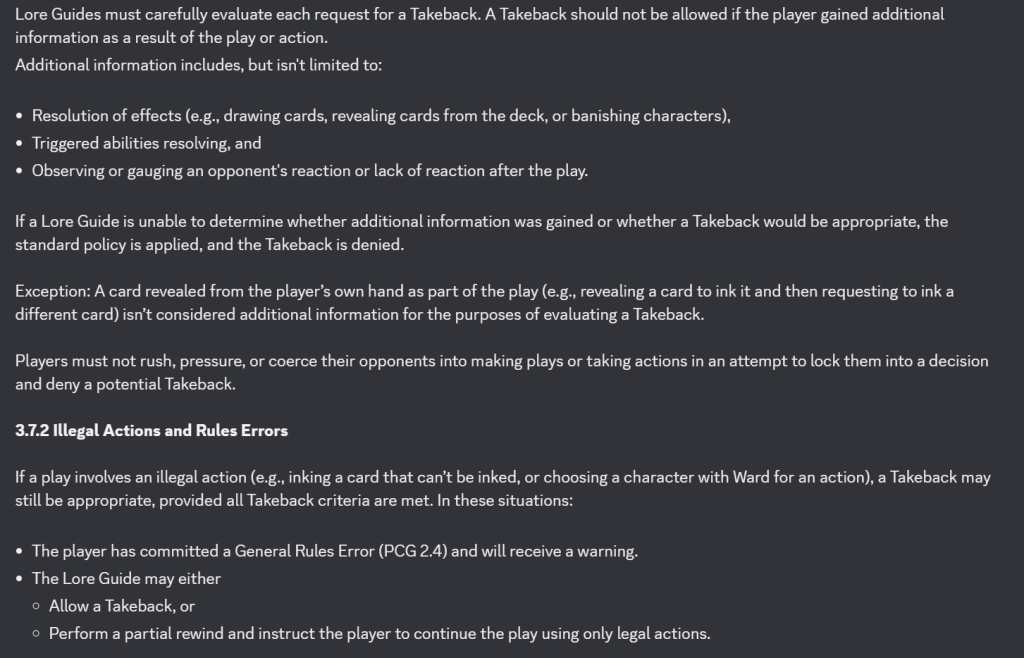
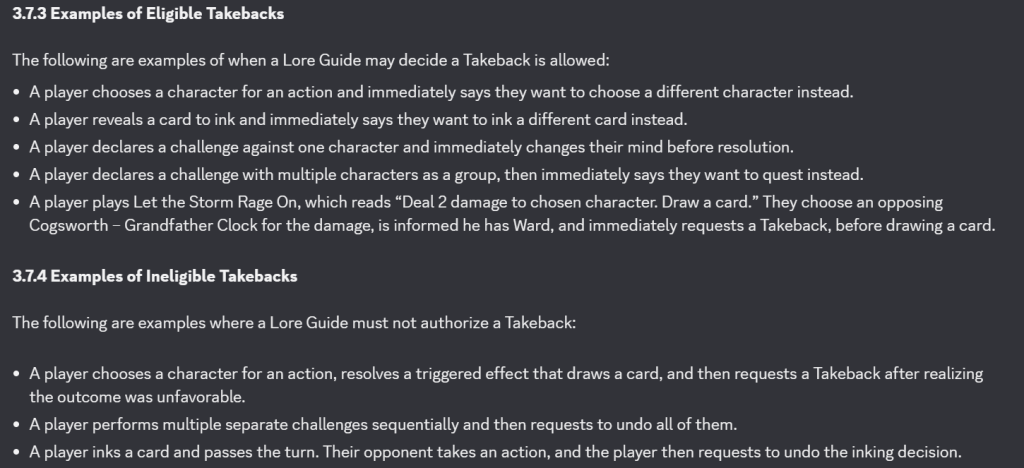
    This marks the second rule that is currently in play that is NOT in the current tournament rules. The other rule being about takebacks:

    We don’t know when the next tournament rules will be available but keep these rules in mind as you go into your next event!

  • Recently, I was asked to present on the topic of Community Building within Disney Lorcana at the first Lore Lights Conference hosted on the Lorcana Rulebook Hub. I developed my slides around my story with the Inland Empire Enchanted community and how building a regional community leads to building yourself a name and job opportunities as a judge.

    Disney Lorcana is still new enough that we all can contribute to its growth and help the game reach its potential!

    Unfortunately, the presentation was not able to be recorded due to some technical issues/planning. But if you’re interested in reading my slides, please do!

    You can find them here – The Inland Empire Enchanted – Community Building and Local Judging

    And if you’re looking for more topics from the Lore Lights Conference check these topics out as well!

  • It’s here it’s here!

    Take your time to read the new Comprehensive Rules Document that just landed, just in time for Winterspell! There are plenty of changes that will be worthwhile for you to learn and adjust to and some things that definitely change how earlier mechanics worked. It will also be quite worthwhile to read through GooglyGlimmer’s set notes to go over how some of the tricky newer cards work in this new iced over world!

    The new CRD has a LOT of new info. While I’ll try to highlight some of the major changes, I have also recruited two of my best judge friends – Ellie O and Jon S – to help uncover new rules. If you don’t know who they are, they have been the driving force and head judges of the recent seasons of Illumineer Champion’s League and the Legendary Cross Continental Clash!

    In this article we hope to review some key changes and how it changes certain card interactions as well!

    1. New Rules
      1. No more singing/shifting for “free”, Section 1.5.5.3 & 6.1.7
      2. Game Action vs Turn Action, Section 1.7.1
      3. No, you can still ask for a Take Back, Section 1.7.7
      4. “Decking Out”, Game State Check, Section 1.8.1.2
      5. “Take” damage, Damage, 1.9.1.5
      6. Shuffling/Cutting your opponent’s deck, Section 2.2.1.2
      7. Ink a Card, Section 4.2
      8. Challenge Declaration step/Damage step, Section 4.6.4 & 4.6.6
      9. Moving from locations finally codified, Section 4.7.2
      10. Action cards enter the Play zone while resolving, Section 5.4.1.2
      11. If you do, Section 6.1.5.1
      12. To [A] or to [B], Section 6.1.5.2
      13. This one will blow your mind – Secondary Conditions, Section 6.2.4
      14. Static Abilities – Continuous and Applied, Section 6.4.2.X
      15. “Skip” Section 6.4.5 and “Enters Play” Section 6.7.8
      16. Resist is no longer a Replacement effect, Section 8.8
    2. Card Callouts
      1. But I thought you said – “NO!” – Do You Want to Build a Snowman?
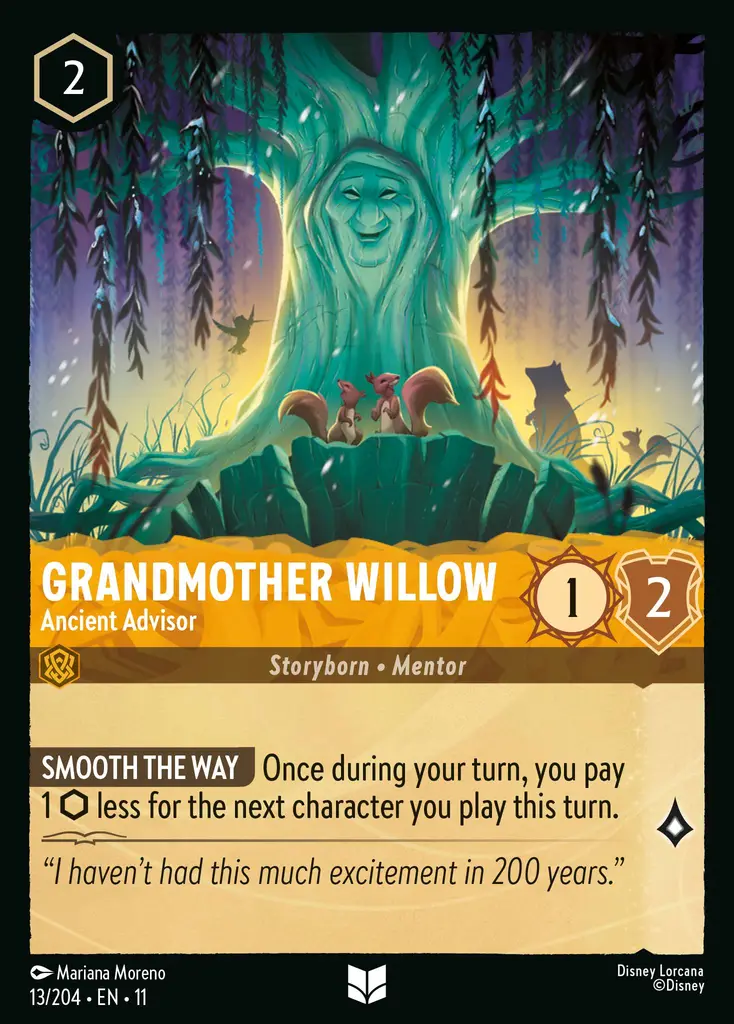
      2. Discounts on Discounts – Grandmother Willow – Ancient Advisor
      3. Lilo – Bundled Up and Rapunzel – Ready for Adventure
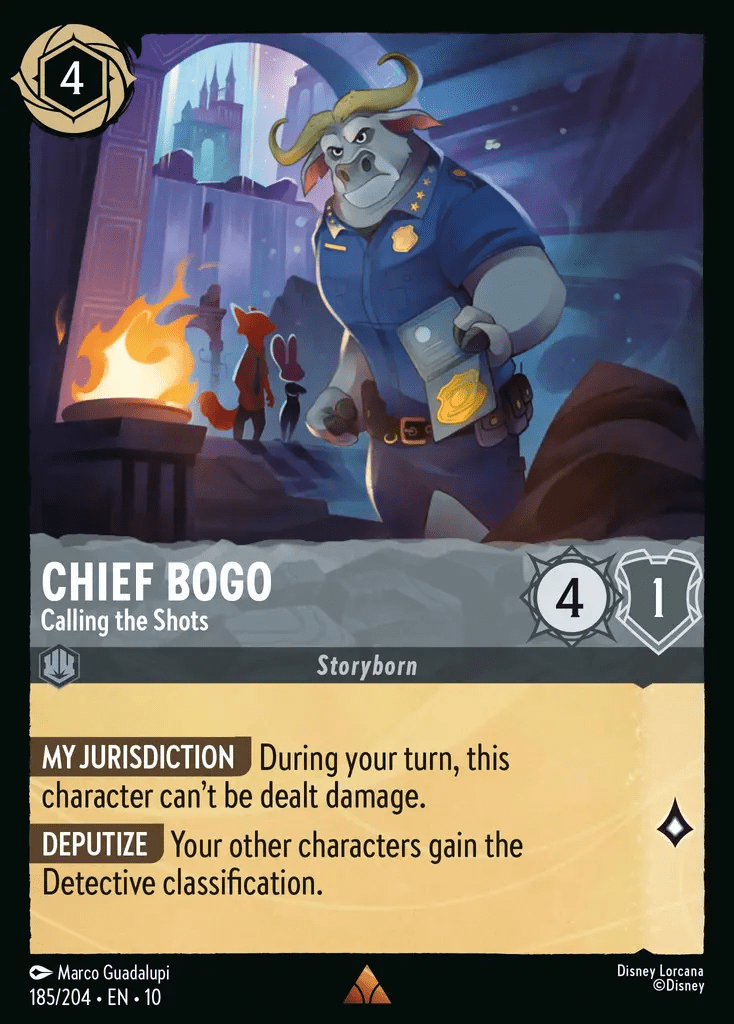
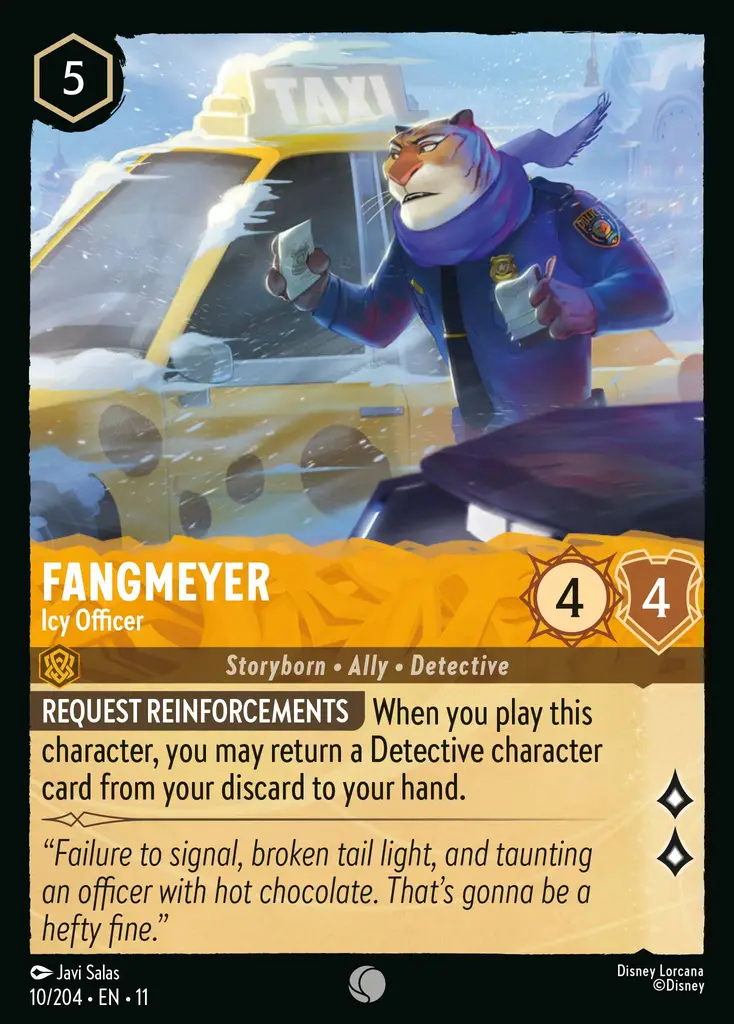
      4. Chief Bogo – Calling the Shots and Fangmeyer – Icy Officer
      5. Sail the Azurite Sea and Belle – Strange but Special
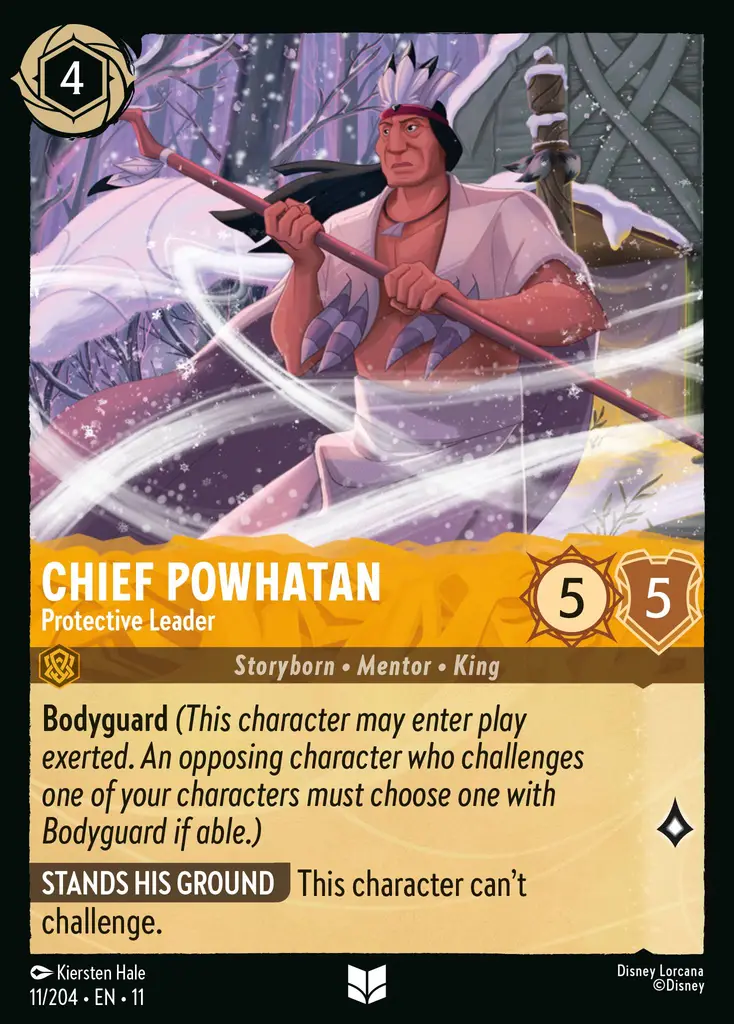
      6. Reckless Chief Powhatan – Protective Leader
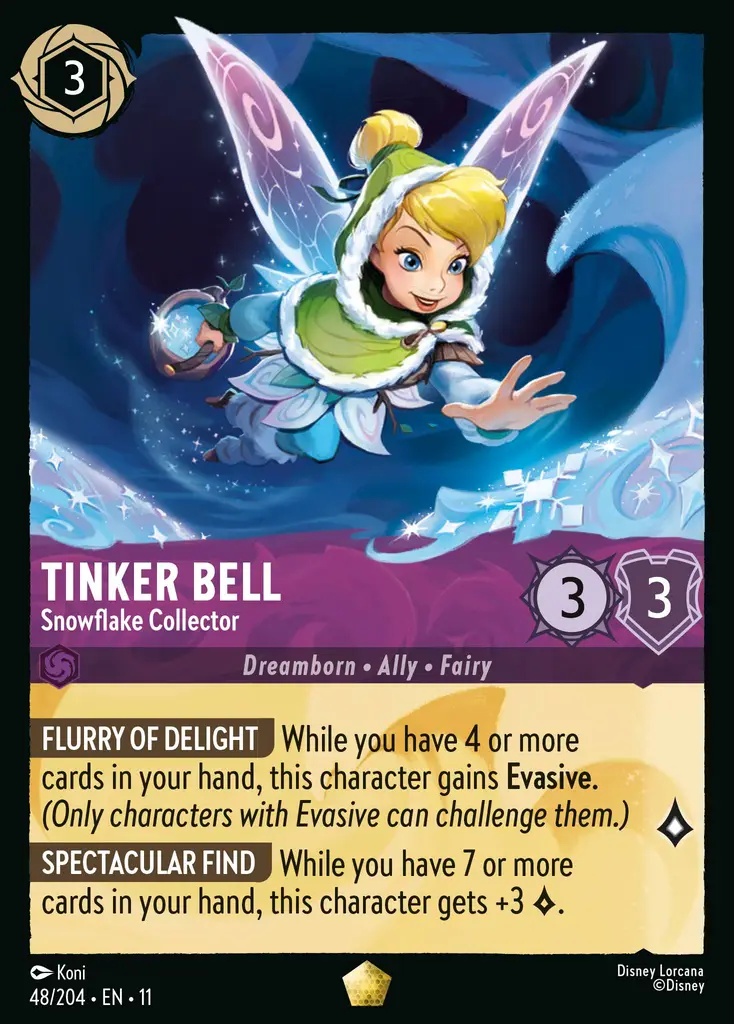
      7. What if I throw Tinker Bell – Snowflake Collector?
      8. Mulan – Resourceful Recruit!
    3. Did I miss anything?
      1. More Resources

    New Rules

    No more singing/shifting for “free”, Section 1.5.5.3 & 6.1.7

    Previously when a card allowed us to play another card for free and that card was a song or character with Shift, we could sing it or shift! However, now with the wording in these sections, if we are playing something for free we can no longer perform any additional alternate costs! Sorry Ursula!

    Game Action vs Turn Action, Section 1.7.1

    We now have a clear(er) definition of what a “game” action is versus what a “turn” action is. Doing things such as exerting a character as part of a challenge would be a “game” action while doing the full challenge is a “turn” action! Also to note in the next sub section, 1.7.2, it clearly notes timing on effects/turn actions!

    No, you can still ask for a Take Back, Section 1.7.7

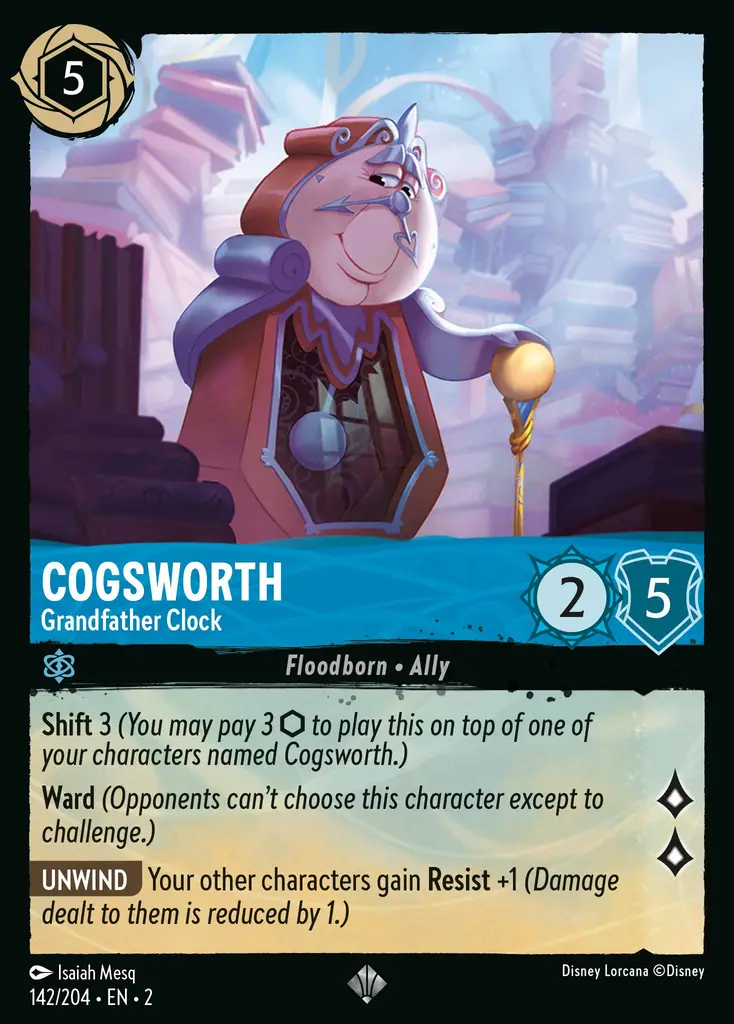
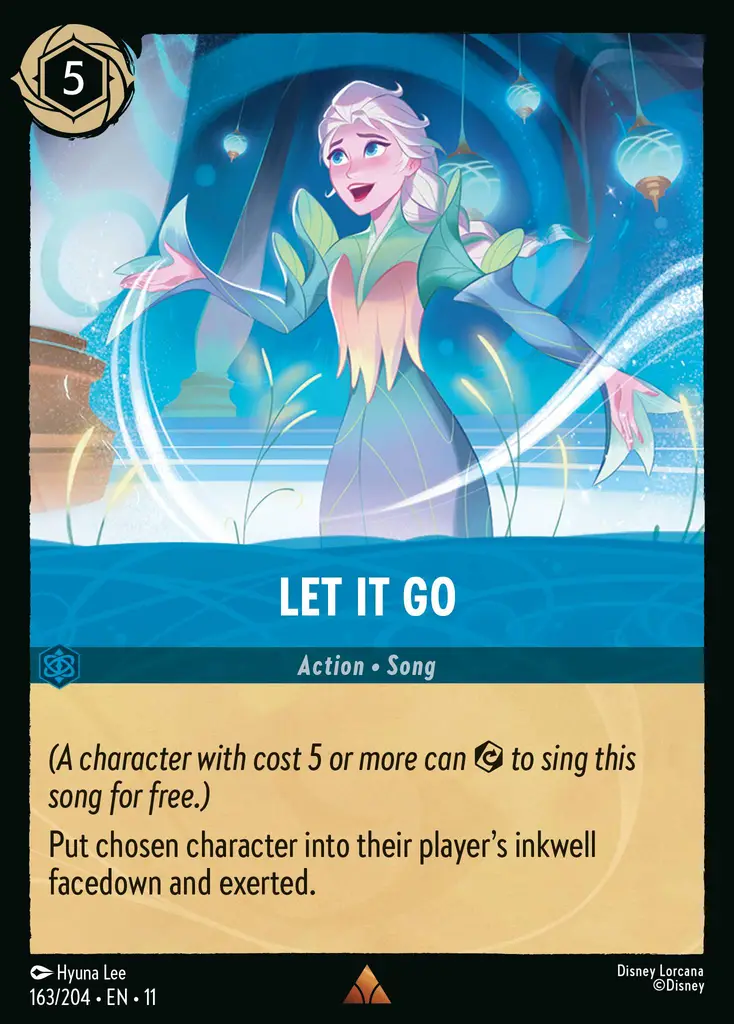
    This one isn’t too special but something that was always used as an example of a misplay or take back. If you played a Let It Go and tried to choose a Cogsworth – Grandfather Clock who has Ward well depending on when and where you did this, you would either have to choose a non warded character or one of your own characters, or be allowed to take it back! While this section says specifically that you must make a new choice, you will always have the ability to request a take back per the current policy on take backs! If this changes, I will scratch out this section!

    “Decking Out”, Game State Check, Section 1.8.1.2

    The section on Game State Checks has been updated to note that a player no longer loses the game when attempting to draw from an empty deck. The player with the empty deck now only loses the game once they end their turn and they have no cards in their deck. So long all of our A Whole New World FAQs on Lorcana Rulebook Hub!

    “Take” damage, Damage, 1.9.1.5

    The word Take has been defined fully in this new CRD. It now includes the fact that a character takes damages when they are challenged/challenging, dealt damage (as in an ability or action), or when a damage counter is put on them (such as Malicious, Mean, and Scary or moving damage such as Cheshire Cat – Inexplicable or Belle – Accomplished Mystic).

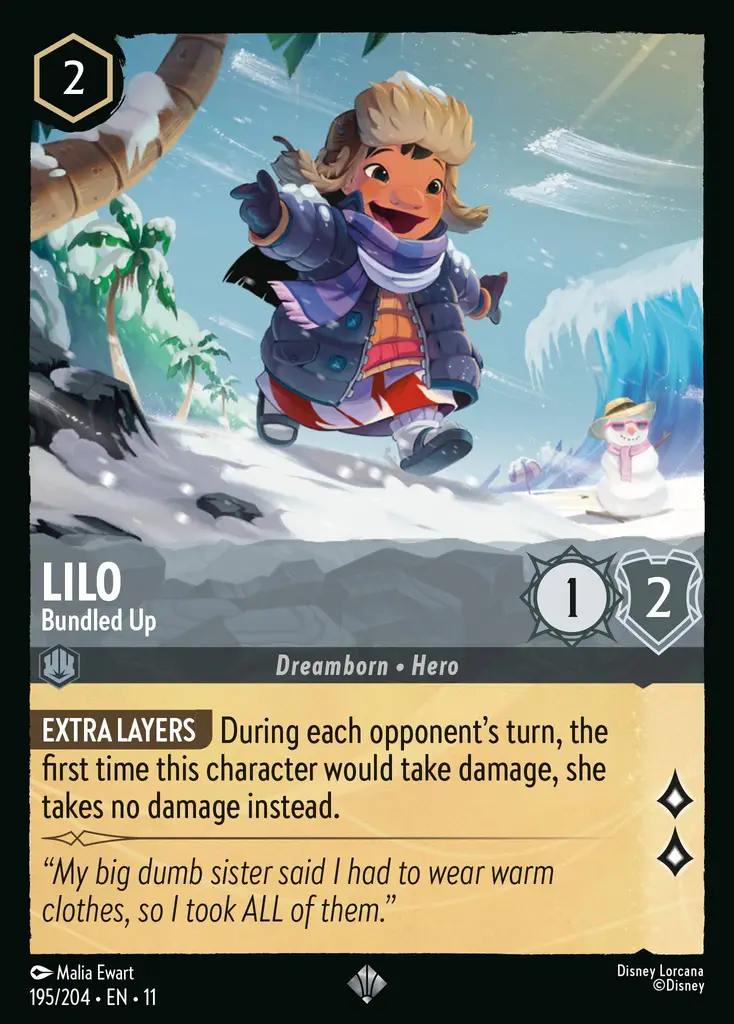
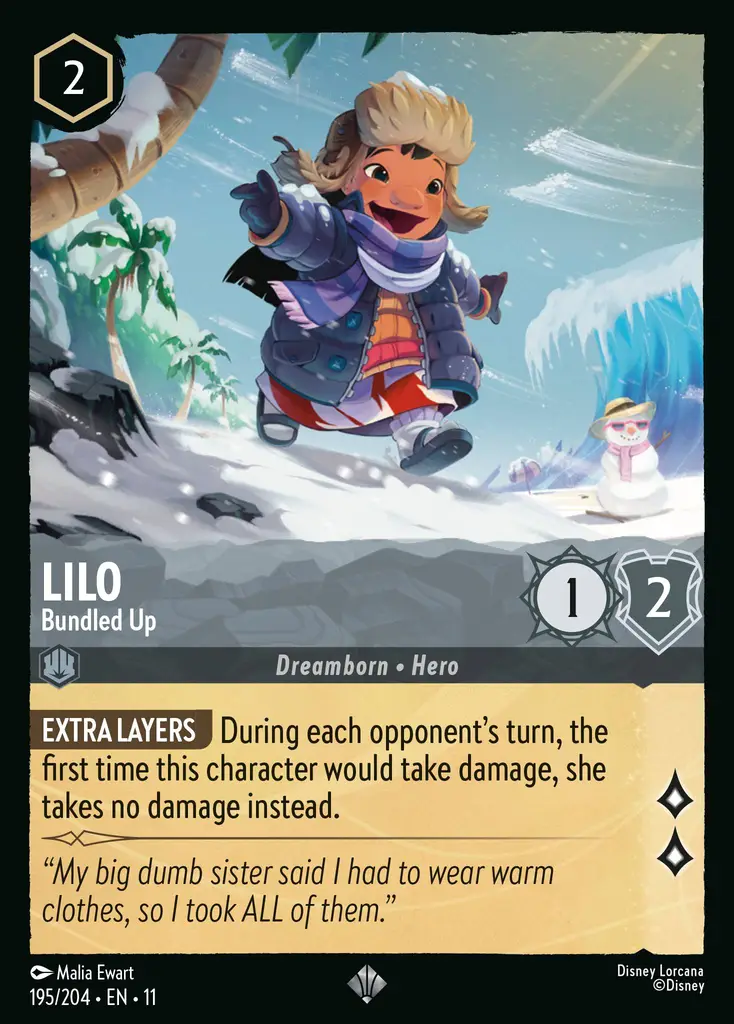
    Let’s look at the new Lilo – Bundled Up. Her ability Extra Layers says that the first time on each opponent’s turn that this character would take damage, she takes no damage instead. It’s clear that when she is challenged or chosen for an action like Strength of a Raging Fire, she would take no damage if it was the first time that turn. In the old CRD an effect like moving damage (Belle – Accomplished Mystic) or putting damage (Mosquito Bite) would actually work! But now, because of the definition of “Take” damage, she takes no damage!

    Before you ask about Resist… there’s more on that later!

    Also updated is that anything that “is damaged,” “was damaged,” “is dealt damage,” or “was dealt damage” means the same as “takes damage!” Section 1.9.2

    Shuffling/Cutting your opponent’s deck, Section 2.2.1.2

    As a call out, during the alter/start of game phase, your opponent has the opportunity to shuffle, cut, or shuffle and cut your deck! You have the opportunity to do the same for your opponent as well. It is also noted here that all cards in a player’s deck should be oriented the same way. As judges we have always asked players to orient their cards the same way because of possible marking issues but now it is fully in the rules!

    Ink a Card, Section 4.2

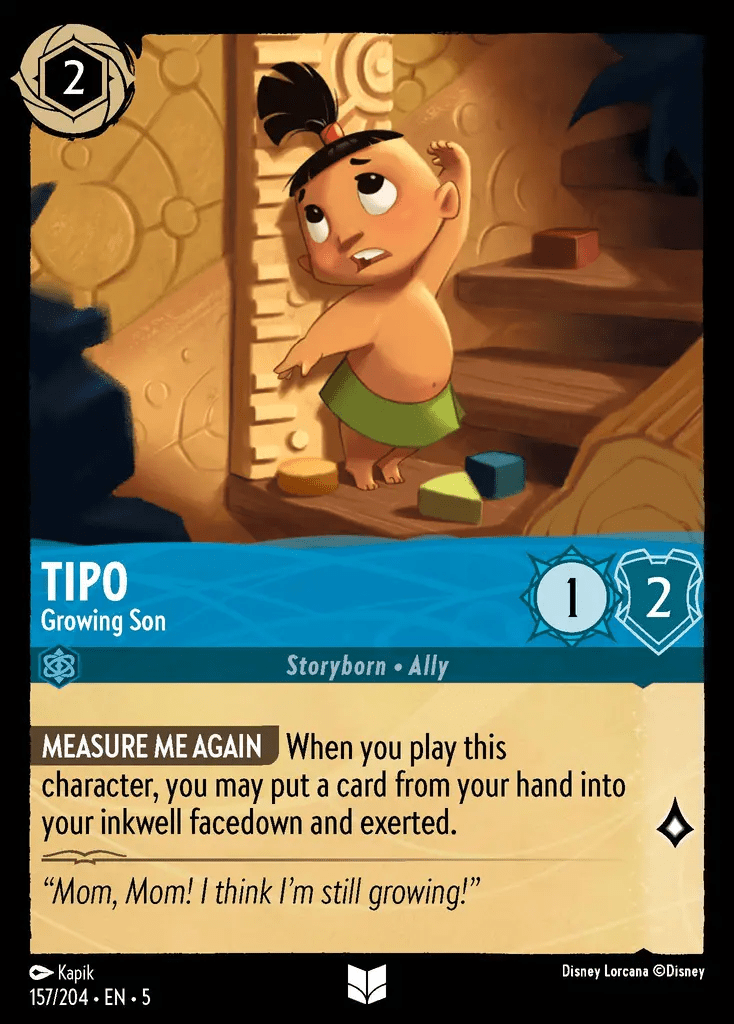
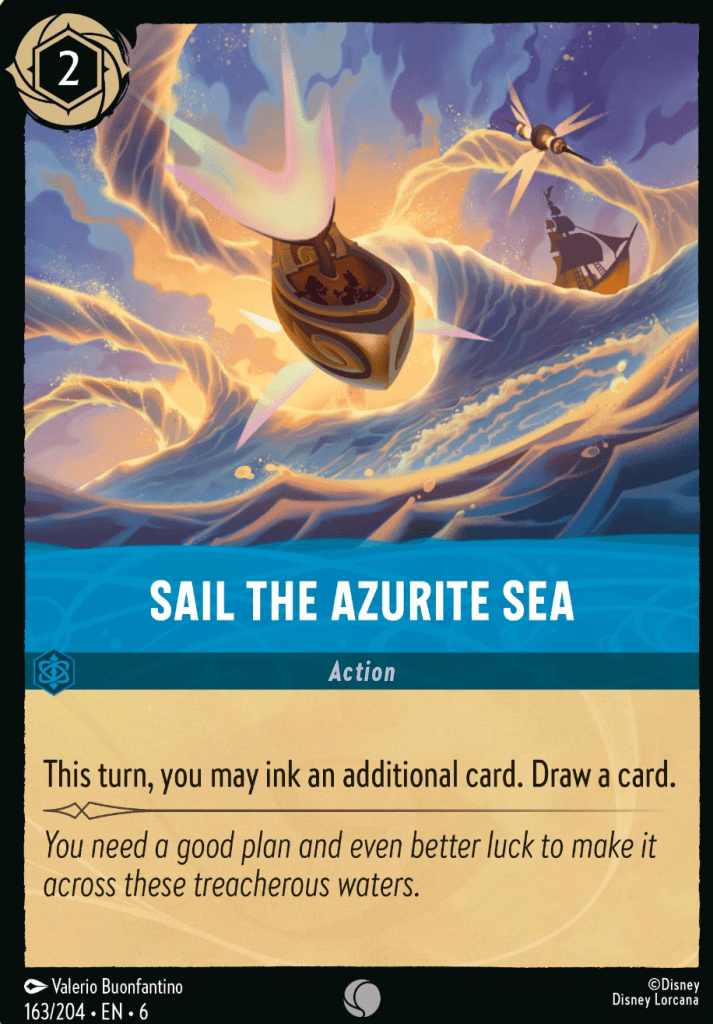
    “Ink” a card has a name now instead of calling it “placing a card into the inkwell.” This section is very important as it also describes the effects of additional ink per turn such as Sail the Azurite Sea versus putting a card directly into their inkwell from cards such as Tipo – Growing Son.

    Challenge Declaration step/Damage step, Section 4.6.4 & 4.6.6

    Just wanted to put kudos here that these are now explicitly called out making it much easier to point out rules of when and where effects that trigger in challenges happen and resolve.

    Moving from locations finally codified, Section 4.7.2

    It is now explicitly noted that characters can’t move from a location unless it is to another location!

    Action cards enter the Play zone while resolving, Section 5.4.1.2

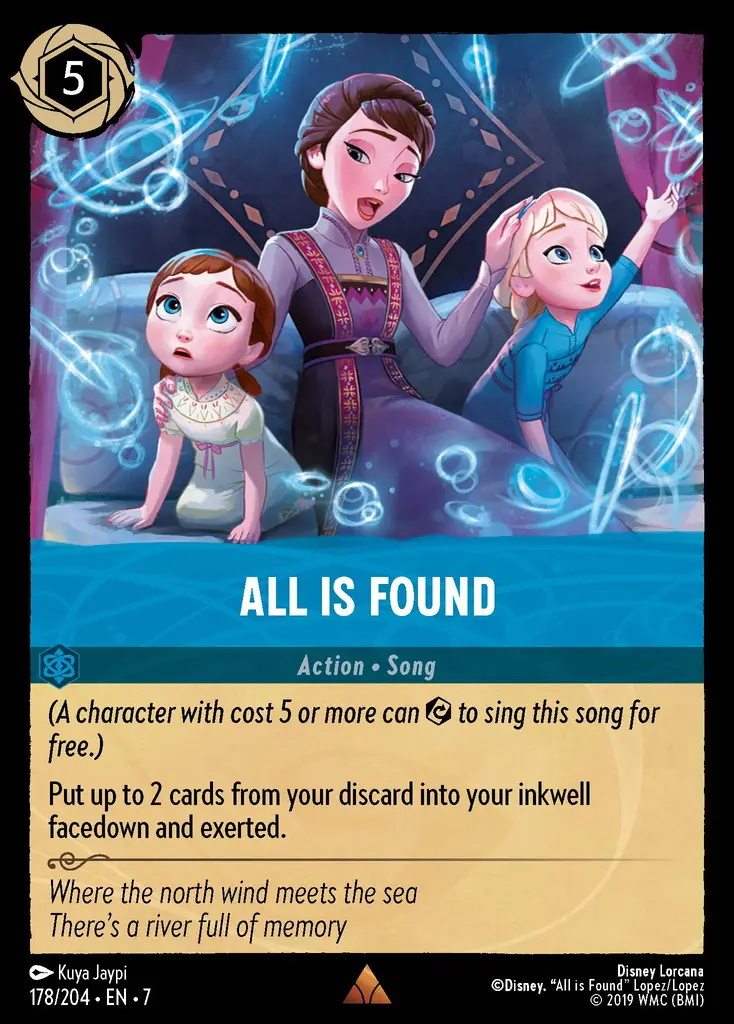
    There has always been questions asked about cards such as All Is Found and if it could choose itself. We now have it explicitly stated that the cards are in the “Play” zone while it is resolving so we know All Is Found can’t choose itself!

    This doesn’t exactly change how actions are played with other effects such as Robin Hood – Sharpshooter or Ursula – Deceiver of All. For those effects, the Action’s effect will still resolve after the respective ability resolves, meaning for Robin Hood – Sharpshooter, the card IS in the discard or with Ursula – Deceiver of All, the card is at the bottom of the deck during resolution!

    UPDATE 2/9/2026

    Kyle Gorbski, the rules manager, just hit us with NEW knowledge on the discord. This change actually DOES mean that cards are held “in stasis” until after the effect that plays the card is done. Here’s an example:

    Previously:
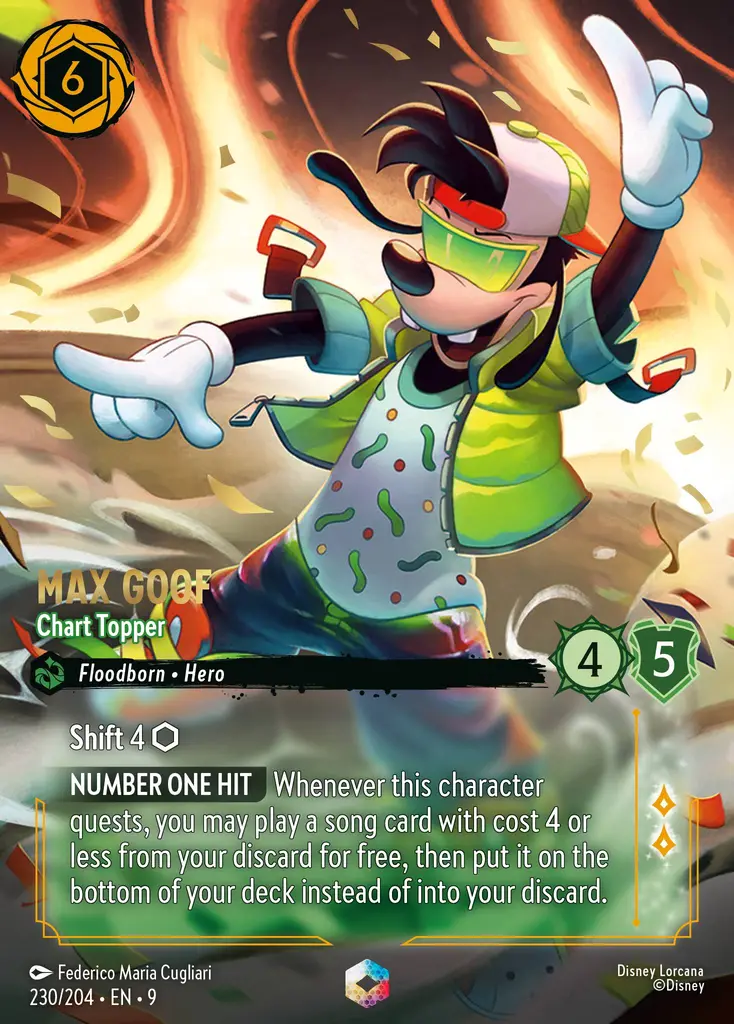
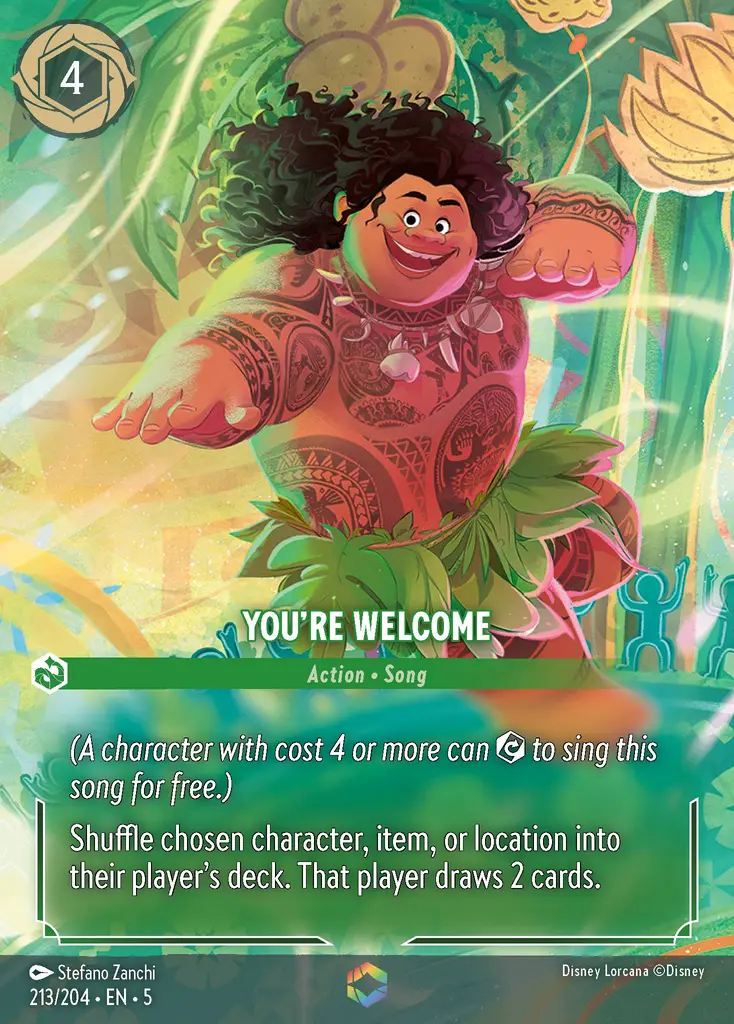
    If Max Goof – Chart Topper quested and played You’re Welcome from the discard, you would actually put You’re Welcome on the bottom of your deck first, then resolve You’re Welcome‘s effect, meaning if you chose one of your own characters you would possibly be able to shuffle and draw into You’re Welcome!

    Now:
    If Max Goof – Chart Topper quested and played You’re Welcome from the discard, you would resolve You’re Welcome‘s effect first (it hangs out in the Play zone), then place the card on the bottom of your deck!

    This means All Is Found can no longer ink itself if played from a different effect!

    If you do, Section 6.1.5.1

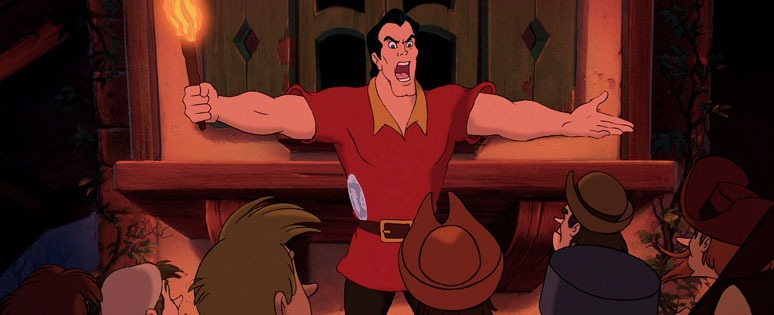
    Ok just saying, they finally added the definition of “If you do” effects. It’s only been… 5 sets since that phrase was added.

    To [A] or to [B], Section 6.1.5.2

    Another thing that has been documented now is that if an effect is an [A] or [B] effect, if you can’t do [A] you must do [B] or vice versa!

    This one will blow your mind – Secondary Conditions, Section 6.2.4

    Way back when I was a fledgling judge, Steve Warner taught us that if an effect had an if condition, you only checked if it was true when it was resolving!

    Then it all changed several months later when our Flounder and savior Kyle changed it on us.

    And now, it’s changed back! It’s a lot of silly history but here’s the important point. A card that has an effect that reads “If…” (and not if you do) would only check the “If” when it is pulled out of the bag!

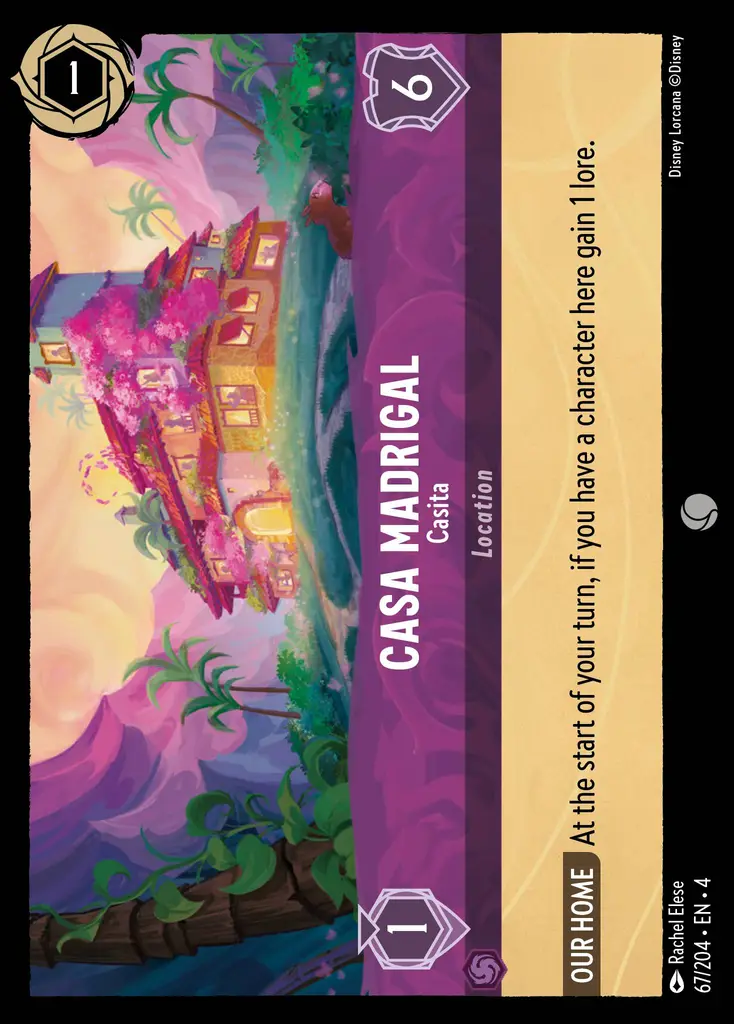
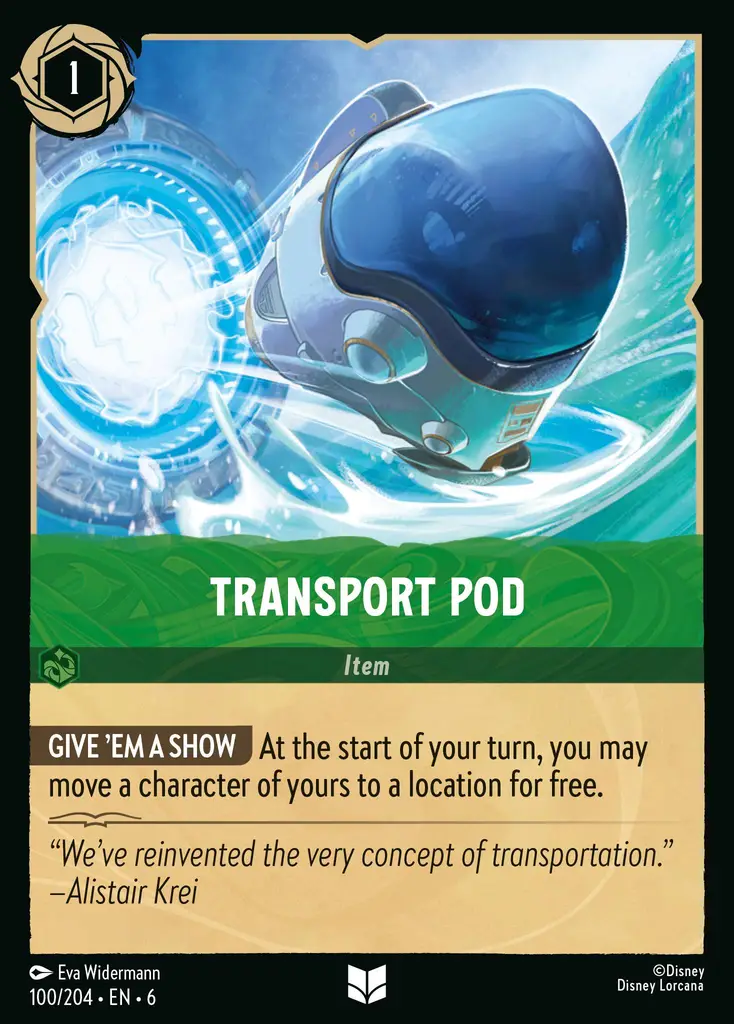
    Recently on the Lorcana Rulebook Hub, we had a rules quiz on Transport Pod and Casa Madrigal – Casita.

    During the time of the Comprehensive Rules between May 2024 and now here’s how these two effects would interact!

    • At the start of your turn, Casa Madrigal – Casita and Transport Pod would attempt to have their abilities enter the bag!
    • If there are no characters at Casa Madrigal – Casita, the effect would NOT enter the bag
    • After the steps in the Set Phase, Transport Pod could be resolved and a character would then be moved to Casa Madrigal – Casita but since there is no marble for Casa Madrigal – Casita, you would NOT gain a lore!

    Now here’s how it would work!

    • At the start of your turn, Casa Madrigal – Casita and Transport Pod‘s effects would enter the bag!
    • After the steps in the Set portion of Start of Turn phase, you could resolve Transport Pod first, then Casa Madrigal – Casita. Casa Madrigal – Casita‘s if condition will be satisfied and you would gain 1 lore.

    We could get into the famous example of three Mufasa – Betrayed Leader, a Be Prepared, and three Stitch – Carefree Surfers… but that’s a lot.

    Static Abilities – Continuous and Applied, Section 6.4.2.X

    Static abilities have better definitions included now that better scope when and how they apply. Continuous Static abilities as cards like Restoring Atlantis grant their effect to everything it can affect during the application window. Applied Static abilities such as Kida – Protector of Atlantis push a static ability that is only applied when the effect resolves.

    “Skip” Section 6.4.5 and “Enters Play” Section 6.7.8

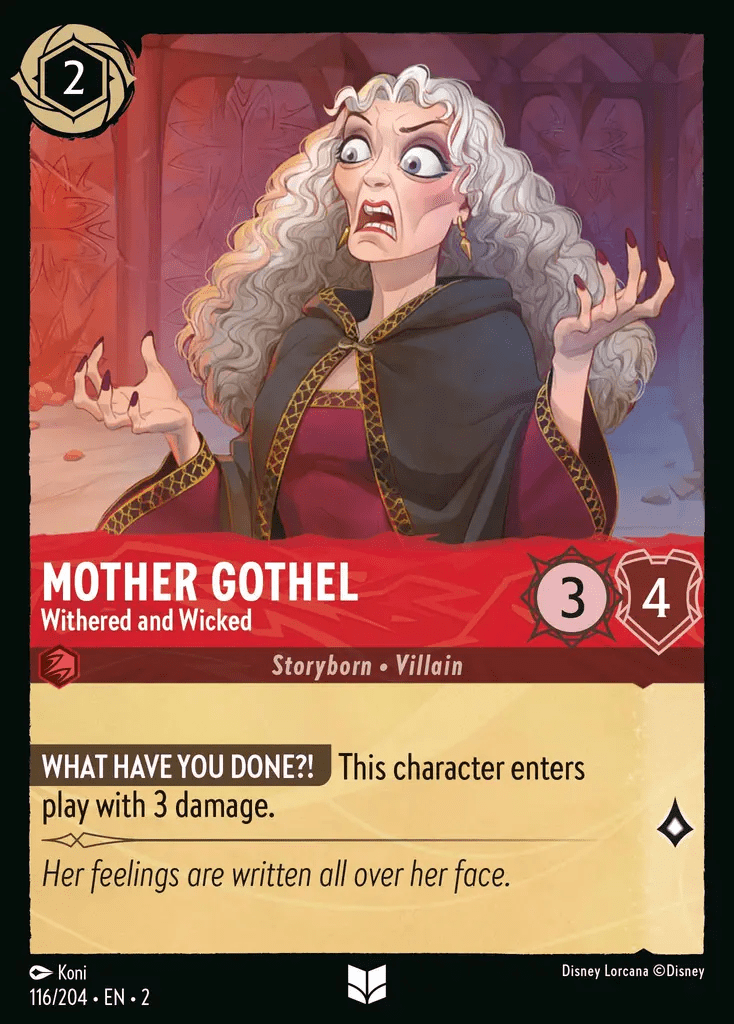
    Previously these types effects were categorized as “replacement” effects but in the new CRD, “skip” effects are static and “enters play” effects just are. For “skip” it no longer replaces what you do, you just don’t do it and for effects like Mother Gothel – Withered and Wicked she just enters play with the damage on her, there is no moment she doesn’t exist (when played) without it!

    Resist is no longer a Replacement effect, Section 8.8

    Resist is no longer a replacement effect meaning cards like Beast – Selfless Protector can now be added back to our rules quizzes… Maybe. This isn’t really a big change but allows for less confusion when dealing with the common Keyword.

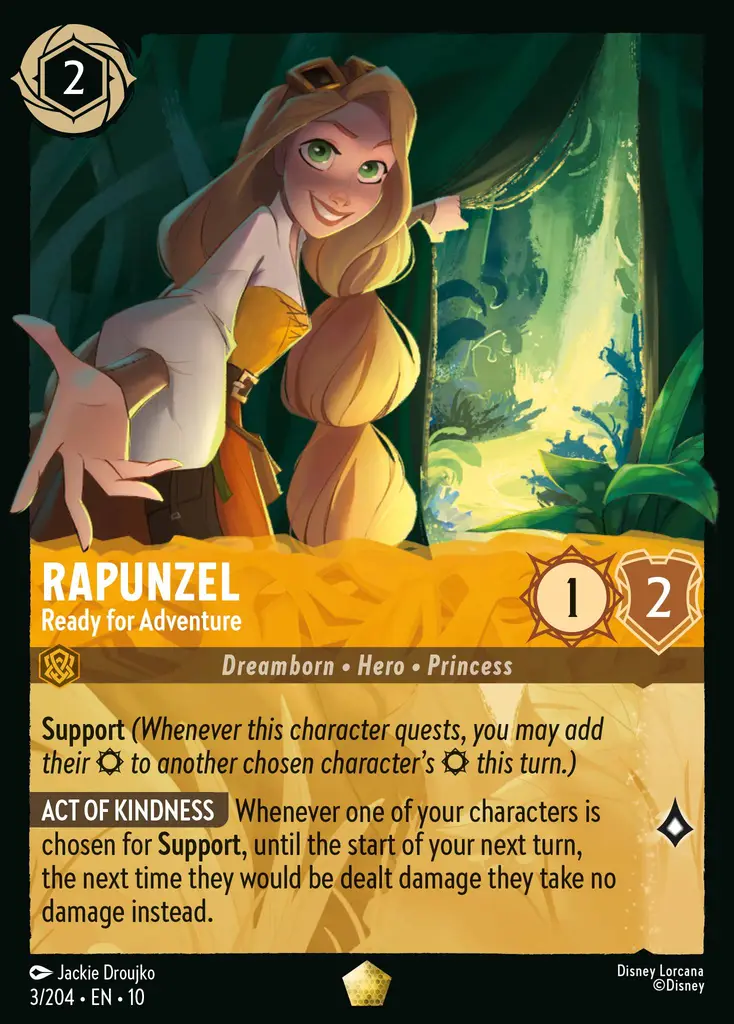
    Also with 6.7.2.2 and 6.7.2.3, keep in mind that REPLACEMENT effects happen BEFORE resist! That means if you give the new Lilo – Bundled Up or support something with a Rapunzel – Ready for Adventure in play, then their replacement effects will replace the first instance of damage before resist happens, and will be used up immediately.

    Card Callouts

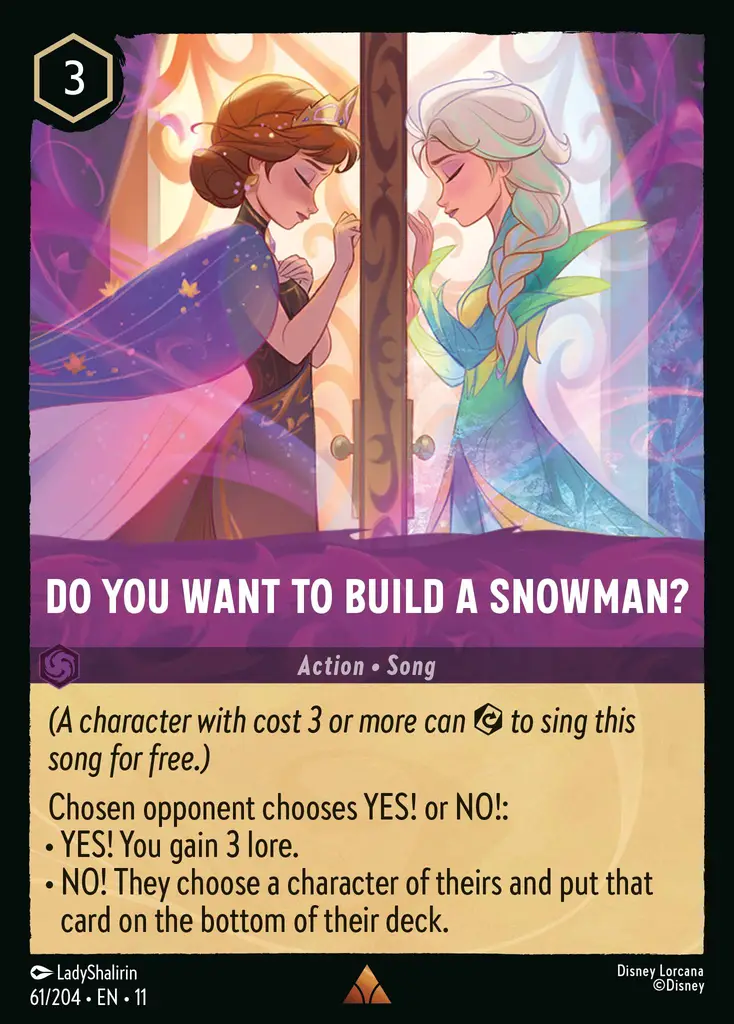
    But I thought you said – “NO!” – Do You Want to Build a Snowman?

    It has been clarified that an opponent may say NO! even if they do not have a character to put to the bottom of their deck.

    This technically goes against the new rules section in 6.1.5.2 but the wording of this card is specifically choosing YES! or NO! not what each ability does.

    I don’t like it. But until they change that, it is what it is.

    Discounts on Discounts – Grandmother Willow – Ancient Advisor

    The new Grandmother Willow – Ancient Advisor has come up many times in questions regarding her ability. In essence she falls victim to Ravensburger trying to make abilities less wordy than other games.

    Her ability reads “Once during your turn, you pay 1 <Ink> less for the next character you play this turn. That means that as soon as you play her, she has a static ability that reduces the ink cost for the next character you play each turn.

    One thing to note though is that if you play something “For Free” it will consume the ability too!

    Lilo – Bundled Up and Rapunzel – Ready for Adventure

    Just to reiterate my above statement. Cards such as Lilo – Bundled Up and Rapunzel – Ready for Adventure will have their effects happen first before calculating resist – as noted in section 6.7.2.2 and 6.7.2.3!

    Also keep in mind how their effects work with [A] to [B] and If you do effects!

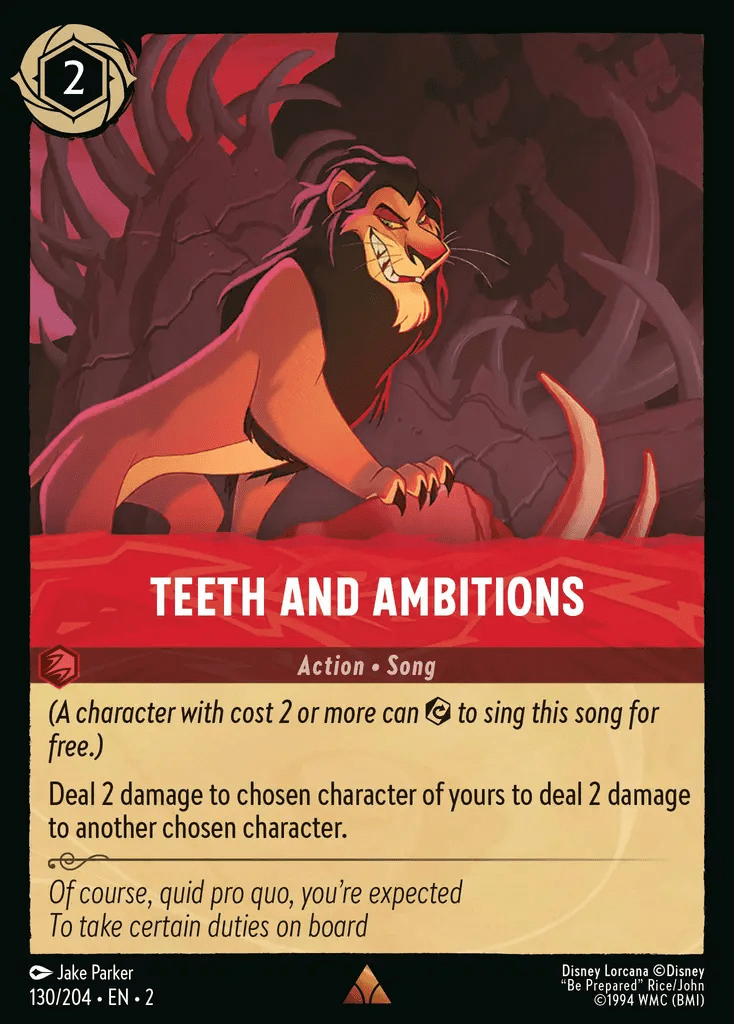
    Let’s say you have a Rapunzel – Ready for Adventure and a Tinker Bell – Fancy Footwork in play. If you quest with Rapunzel and support Tinker Bell, then play Teeth and Ambitions choosing Tinker Bell, then you would NOT be able to deal 2 damage to another chosen character because the [A] in Teeth and Ambitions was never done! The same would be said if Teeth and Ambitions read “Deal 2 damage to chosen character of yours. If you do, deal 2 damage to another chosen character.” It would be the same! The replacement effect means the event never happened and thus does not satisfy the condition.

    Chief Bogo – Calling the Shots and Fangmeyer – Icy Officer

    Characters are only Characters in play, otherwise they are Character Cards so Fangmeyer would not be able to get any Character Card from the discard but only those that have Detective printed on them!

    Sail the Azurite Sea and Belle – Strange but Special

    Check the Disney Lorcana app for these updated cards but they now reference the turn action of Inking a card to lower the confusion around them!

    Reckless Chief Powhatan – Protective Leader

    If you give Reckless to Chief Powhatan, he will not be able to quest or challenge! He can still sing though.

    What if I throw Tinker Bell – Snowflake Collector?

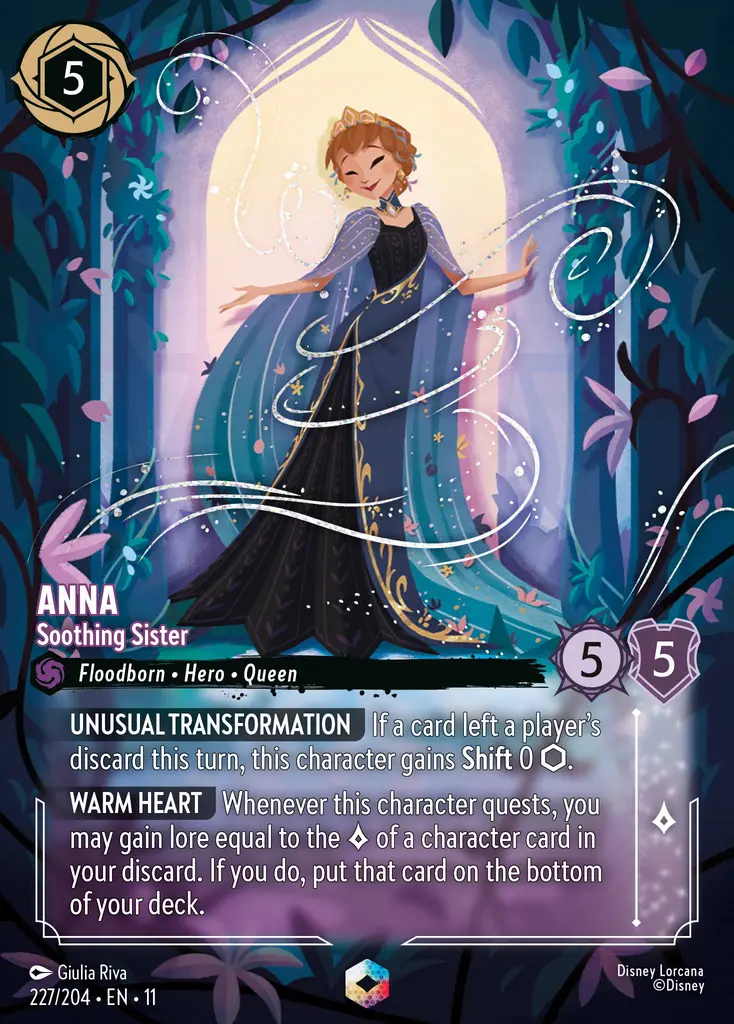
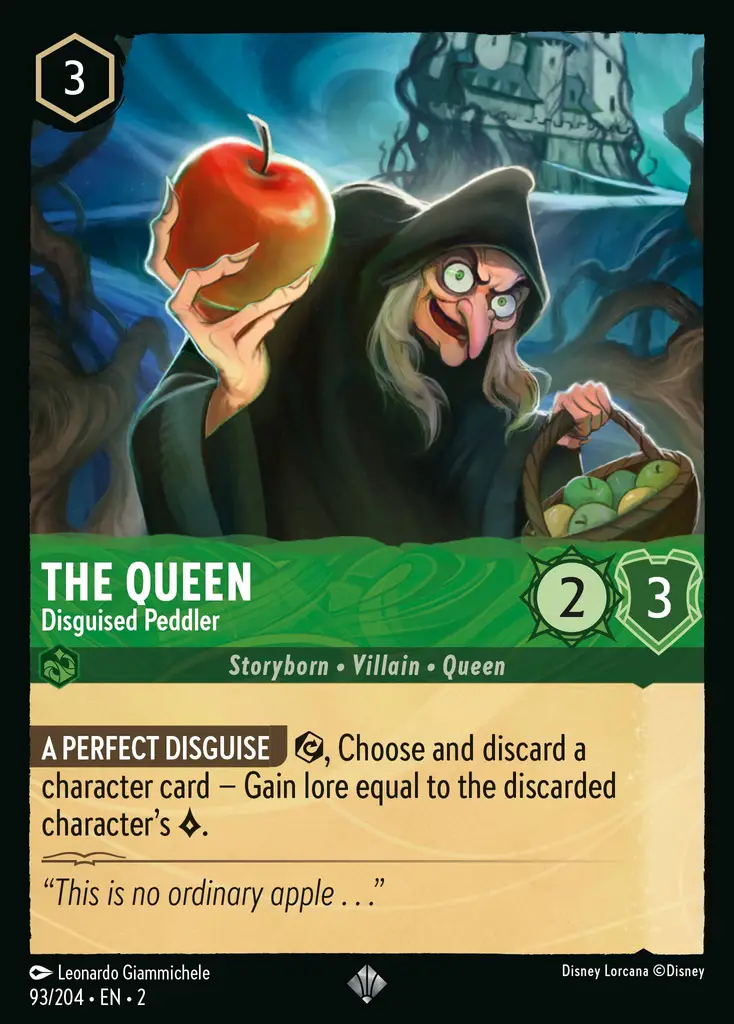
    Effects like Tinker Bell – Snowflake Collector only work while this character is in play! So questing with Anna – Soothing Sister or using The Queen – Disguised Peddler‘s ability will not get the extra lore from Tinker Bell – Snowflake Collector… They will however work with Flynn Rider – His Own Biggest Fan.

    Mulan – Resourceful Recruit!

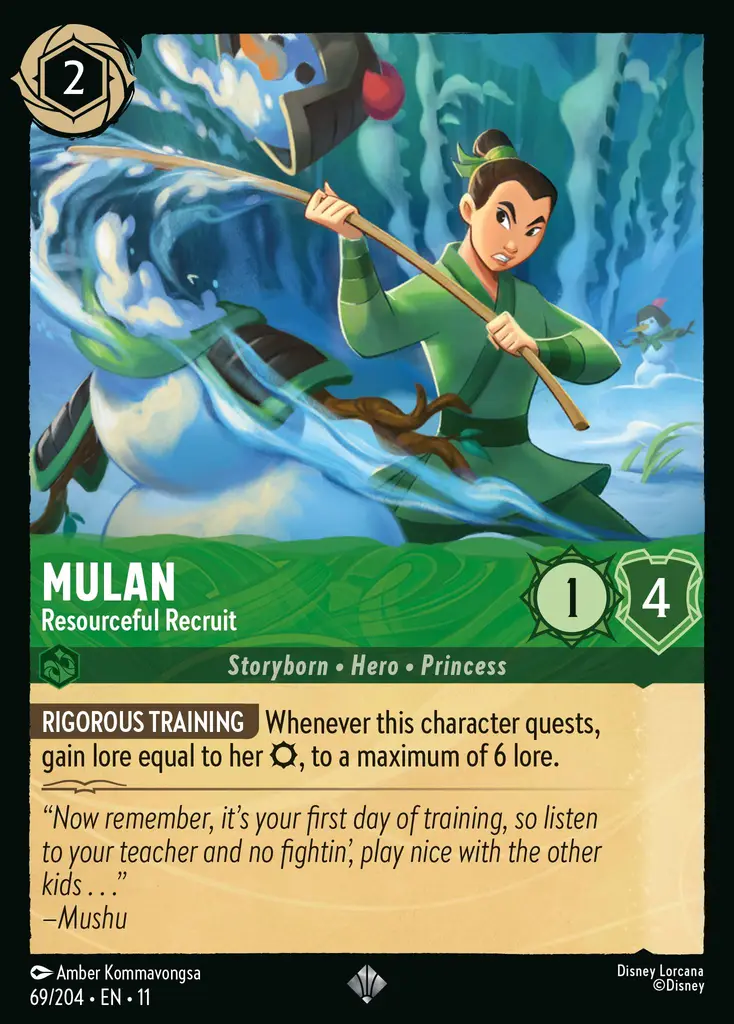
    In my mind, there is no doubt that this character will see play! By her existing it actually answers the common question of “If a character has no lore can it still quest?” The great thing about Mulan is that if you were to give her lore from an action or ability such as Good Job! or The Eye of Fates as well as boost her strength from Support or some other effect, she will gain her lore from questing and then her effect! So she can gain more than 6 overall.

    Did I miss anything?

    If I missed anything please DM me or leave a comment! I’d be happy to add to this article. I listed all the big changes that I saw but obviously there were a ton of changes, wording, and clarifications that all could be important to know!

    More Resources

    Check out Ellie O’s Fact Sheet!

    Check out GooglyGlimmer’s LoreLicense site for more in-depth analysis! And here’s a direct link to his Rules 2.0 review!

    If you have questions you’d like to ask some Lore Guides, consider joining the Lorcana Rule Book Hub!

    And as always, come discuss rules directly on Disney Lorcana’s Discord!

  • For those that don’t know, the ICL – Illumineer Champions League, is an online league hosted by Luke Goodwin (aka vVonderland). It is a league meant to highlight some of the top teams across North America and spotlight some excellent meta defining gameplay. For season 2 my best judge friends Ellie O and Jon S were the head judges while I took a step back due to increased family responsibilities! Season 2 was definitely much larger in scope and need and they had their hands full! Below I bring you Ellie O’s tournament report!

    And just as a heads up! Season 3 of ICL is just around the corner and you can catch the action on Luke’s twitch!

    1. Tournament Report
      1. “Don’t underestimate the importance of body language…” – Ursula
      2. “… I cannot read.” – Winnie the Pooh
      3. “Here we come, we’re fifty strong, and fifty Frenchmen can’t be wrong!” – The mob
      4. “Leave the saving the world to the men? I don’t think so!” – Elastigirl
    2. Learn More!

    Tournament Report

    The Illumineer Champions League (ICL), Season 2, was an online, team-based, competitive tournament series of Disney Lorcana that occurred from October 2025 through January 2026. The league comprised 18 teams divided into two divisions; Division A played on Tuesdays, Division B played on Wednesdays. The tournament structure was 9 rounds of round-robin (one team in each division on bye each week), with a cut to top 12 (the top 2 teams of each division were given a bye for the first round of top cut).

    Each league night (Tuesday and Wednesday) had four matches occuring: one Feature Match which was streamed and commentated, and three others. All matches were played on the ICL Discord server via web-cam.

    There were nine active judges throughout this season, and two additional support judges who worked in an administrative/mentorship role. Each league night utilized one Head Judge, one Feature Match judge, and one to three judges on the other three tables. 

    For context, the previous season of the ICL was a much smaller scale, with only one match happening a night—so fewer matches and teams overall, but every match was streamed to Twitch. 

    We really did not foresee the substantial challenges we would face by expanding the league. Season 2 of the ICL was tough; through our three months, we had times of unhappy players, overwhelmed judges, and opportunities to reevaluate the worth of the endeavor. 

    And in the end, Enter The Battlefield just beat SLTC again anyway, so what was the point?! Just kidding. The impact of ICL is something that the players and judges rarely see, as they’re focused on the match in front of them; it’s the space we created for the Disney Lorcana community that has tuned in every Tuesday and Wednesday night to check out meta shifts, chat with fellow spectators and our world-famous casters, and cheer on their favorite teams.

    And now that Season 2 is over, we can take what we learned into the next season, and beyond…

    “Don’t underestimate the importance of body language…” – Ursula

    Some errors covered in the Play Correction Guidelines seemingly have little to do with the game of Disney Lorcana and everything to do with how players communicate with each other and with tournament officials (TOs). One of the more nuanced elements of judging is observing player interactions: communication cues, facial expressions, and body language. These elements help us see when players are joking with each other versus being unsporting.

    Now imagine you can’t see their faces, you can’t hear their voices, and every single player interaction is publicly viewable by all players and TOs.

    If you are judging a 2,000-player tournament, and two players conspire to submit improper match results, but they do so in the bathroom while you are 300 feet away in another room taking a judge call, I think we can agree that catching and addressing that error is out of scope for your role; judges cannot listen to all players at every moment, that’s just not possible. 

    But what if the venue is online, players communicate via text messages, and every message is viewable by every player and TO at any time?

    Hosting the ICL on Discord led to a unique challenge of examining and clarifying the scope of the judge role in an online setting. Because we as judges had access to everything players were saying, we felt responsible for addressing messages which might be considered unsporting without the context of body language or other communication cues. We also were cognizant that all other players would be able to read each message, so topics that one party felt appropriate might not have been appropriate to others.

    We became Discord mods–oops! 

    Lesson #1:

    In an online tournament, judges are not mods. The TO should have moderators that oversee server communications outside of match times. 

    “… I cannot read.” – Winnie the Pooh

    The judge and TO teams relied on documents to keep us organized during the long season:

    • Judge Guide – workflows and links to tools used each round (team rosters, decklist submissions, and the penalty record sheet).
    • Tournament Guide – a document with the tournament overview, schedule, all rules, and decklist submission links.  

    While some players and judges used these documents as intended, some probably never read them, based on questions that were asked and errors that occurred throughout the season. While this method of collecting all the rules in a single document was easiest for me, it does not seem useful to everyone. Some ideas:

    • Better organization in the Discord Server, so that applicable information was presented to the players when and where they would use it. For example, the decklist restrictions and penalty for late submissions could live in the channel called “Decklist Submission”, where players access the form to submit. 
    • Keeping the information channels clean, deleting old messages (old decklist submission forms), so that players were only ever seeing the information needed for the current week (round).
    • Rely on Team Captains to ensure their team read and understood rules documents.

    At the end of the day, we cannot read it for them. We could make all these changes, and some players would still not read the rules. 

    And due to the nature of a team-based tournament, one player’s error inevitably affected the entire team, which may be one explanation for the frustration we felt from players who unknowingly broke a rule. 

    Lesson #2:

    The more elements you add to a tournament (new decklists every round, teams, divisions, multiple matches happening at once, web-cam gameplay, etc.), the more important organization and concise communication will be. 

    “Here we come, we’re fifty strong, and fifty Frenchmen can’t be wrong!” – The mob

    When you have rules for an event, and a number of people unknowingly break those rules, things can get… hostile. Two is company, three’s a crowd, any more than that and everyone might start singing The Mob Song. 

    Long-form tournaments require substantial dedication from players, as they show up every week for basically a new competitive tournament each time. Here’s what I mean: An event that spans a set release means you likely need to allow players to update decklists. Weekly decklist changes mean that players need to submit new decklists each week. Giving casters and judges time to review decklists means the lists need to be submitted at least a few hours before the player meeting. For us, that meant submissions were due at noon Central Time, while most players’ minds were far from the realm of Lorcana. 

    Players that don’t submit their list in time must receive a penalty. This was, surprisingly, the biggest pain-point for the ICL this season. According to the Play Correction Guidelines, the penalty for a missing decklist is a Game Loss. The judge team felt that would not be sustainable, since there were at least 8 more opportunities (9 weeks total) for each player to commit this error than there would be in a regular tournament, so we decided a better penalty would be loss of play/draw choice for that player’s first game.

    Still, technology can be clunky for players, and the constant feedback we received was that the decklist submission process had too many points of potential failure. Over the season, we had at least 34 Deck/Registration Errors, which means this is an area we must improve. 

    Lesson #3:

    The best tournaments are ones that are decided by gameplay, not by penalties. If you are constantly issuing penalties, you should ask yourself what systems can be improved to help players succeed. 

    “Leave the saving the world to the men? I don’t think so!” – Elastigirl

    Throughout the season, as we wrestled to identify what the role of Judge should be in an online tournament, I received some feedback that was troubling to me, such as: I was taking the event too seriously, I was abusing my authority. 

    Players seemed to feel the rules for ICL were too strict and penalties too harsh. I was initially baffled—these teams paid a $200 buy-in, and this was a competitive event. I thought they would expect the judges to uphold the rules to the best of our ability at all times. 

    At first, I was disheartened. I personally don’t have many local opportunities to judge, so I don’t have as much Head Judge experience as some of my peers, so it’s embarrassing to see that I had failures within my role in the ICL–I love helping players, that’s what I thought I was signing up to do. But given the context: our accidental role as Discord mods, not finding a successful way to communicate the many rules of our unique tournament, and the players’ struggles with the neverending decklist submissions… this feedback makes sense, and I don’t think I will take it personally.

    While I believe I was meeting the expectations of the TO, this feedback shows that expectations were not fairly set for players, and that means we have work to do! 

    For Season 3, we are making changes to better align the ICL with our players’ desires and expectations. Jon, Phil, and I are continuing in our roles and substantially redistributing our judge resources so that we can meet player needs while not overstepping our role. 

    Learn More!

    Find more Ellie O on X and BlueSky and get the latest updates on the ICL on X.

    1. Oxygen Not Included
    2. Metrics Metrics Metrics
    3. Communication
    4. Key Takeaways
    5. My Interesting Call
    Oxygen Not Included

    If you have ever played the game Oxygen Not Included, a survival/space sim, you’ll have a good grasp of what head judging a 2000+ player event feels like. There are some quiet moments and there are some staggeringly difficult moments. It all comes together with how you can direct and manage the resources.

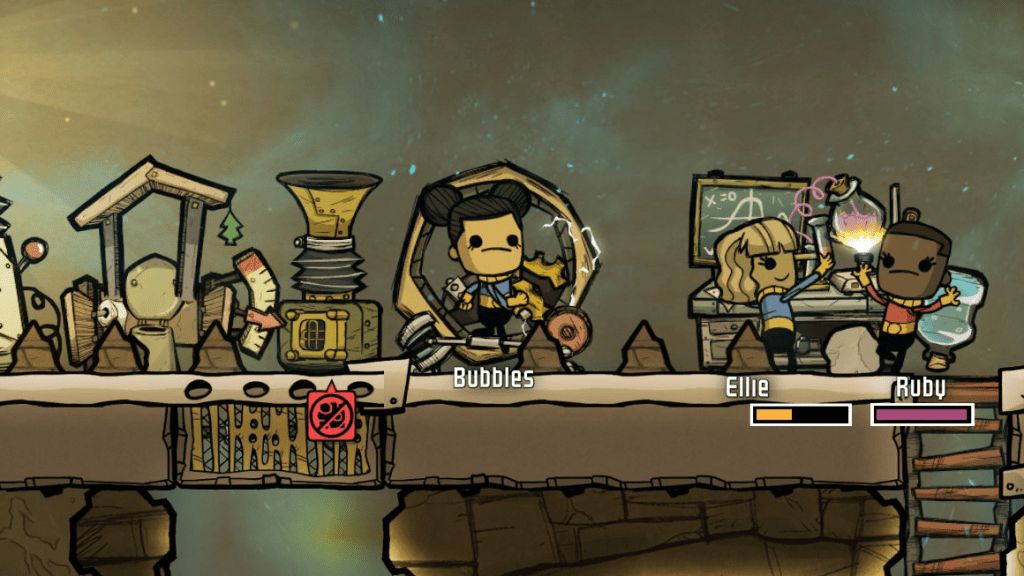
    A capture from Oxygen Not Included

    In the game, there are scientists you hire and direct to do tasks across the little rock you are trying to survive on. Build, re-wire, create a clean water system, create an oxygen system, ensure food, etc. These scientists generally know what they are about but can be given the wrong tasks or even try to be heroes and take on too much themselves. This leads to small cascading chains that can build up and start larger fires in the overall infrastructure. You as the overseer have to ensure this doesn’t happen. Or at least that it doesn’t happen in which your rock explodes and everyone dies.

    It’s obviously not as dramatic at the DLC. Pastimes is there to help ensure no major fires and they have a great infrastructure already in place to prevent any disasters. The judges/lore guides are hired to work within that eco system and ensure a solid event. But there are times where small fires compound into larger ones. One small time extension suddenly bubbles up and causes longer delays. A wrong setting or not fully configured portion of Ravensburger Play Hub leads to confusion and needing to create new processes on the fly.

    It is our job, as the lead lore guide, to ensure that all the small things that build up are smoothed out behind the scenes to prevent major mishaps and ensure customer satisfaction. I honestly believe that the entire team was able to deliver on that aspect.

    Metrics Metrics Metrics

    I honestly don’t know if I had any impact on the event. When I first started, I was trying to put on the boots of giants. During the last DLC I worked with amazing appeals and head judges in which I soaked as much information from them as I could in preparation for eventually being in their position. I just didn’t realize it would be so soon. I have been thanked by a lot of my friends who were at the event as well as others who know me from social media about just how well my event was, but honestly I attribute that to Pastimes.

    Pastimes had listened to feedback and worked towards better serving customer expectations. Prizing and tickets were adjusted. More activations were had. Other than a prizing issue with a single event (which has now been addressed), I feel like almost everyone was happy with how they could participate and be awarded at the DLC. I saw many many people thanking Meg and Pastimes in the Pastimes Discord when just a week before there was so much vitriol in the same space as the days ticked down to the DLC.

    One thing I am still learning is that if the system is working and working well, it’s almost invisible. It’s like having electricity. It’s there, it’s just part of your life. But the second that it’s out or there is an issue, it becomes a major thorn in your day. One measurable metric that I could time and check in on is our round turn overs. While these metrics aren’t exactly public, one of my appeals judges helped compile data on our round turn over times and well, anyone with a phone and a good notion of listening to when we call time can compile the same. Publicly, there were some grumbles about how long it took for players to start playing again, especially if they ended their match quickly.

    Overall we averaged about 26 minutes from when I said “Illumineers in the main event, that is time in the round…” to “Illumineers pairings for your next round are posted…” Personally I can agree that I want to get that lower. But I’ve been told, it’s a fairly solid turn around time. On day 2, in a much less crowded room, our turn over times were 14 minutes!

    A metric that is harder to measure is how much our floor judges were on the same page. A major hurdle I had was aligning judges to policies and behaviors. I made it a point to talk to all of the judges working the main event about how I wanted take backs to work in accordance to follow up discussions with Ravensburger as well as trying to ensure all judges kept a friendly demeanor and clean area for our players. What I failed (?) to do was communicate that clearly across the entire event. More on that in the next section though…

    Communication

    Let me preface this again that this was my first time Head Judging an event of this caliber. I have always been close to the leadership and have worked hard to get as much time/mentorship from other leaders but this was my first time taking the plunge as it were. There were definite gaps in communication both from myself and working with Pastimes as an org and that’s not really anyone’s fault. It was a mix of my own naivete and possibly Pastimes understanding of my experience. All in all, it left me with a lot of notes on how to improve.

    When I first got the tap to be head judge, I immediately dived into all of the preparation work that I thought would be required. If you know me, I like to be as prepared as possible so that when things inevitably break, I have worked through some countermeasures or have thought through processes that can be in place to address it. Pastimes is a great tournament organizer with tons of experience, but they are also busy as heck. During their time of preparation, they had a Magic Con, a PAX, and the US holidays to contend with all leading up to DLC Richmond.

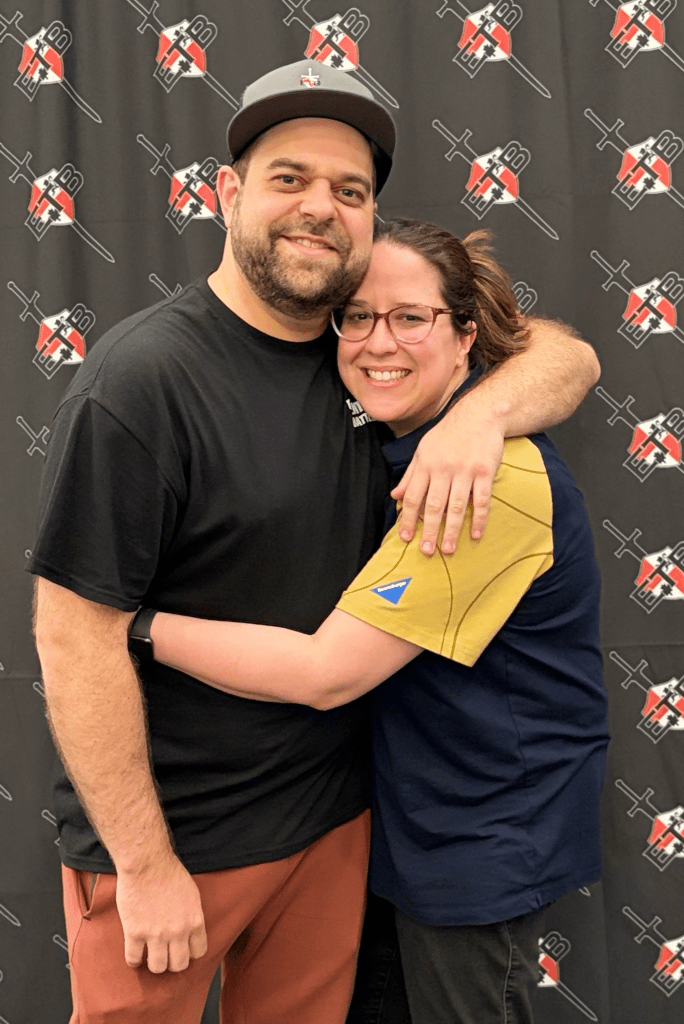
    What that is all to say is that there was a lot of work I thought I needed to do that Pastimes did not want me to do and then a lot of work that I probably could have done better or focused on was not relayed to me. One of my key take aways from the weekend is that I could have set up some of my teams for better success by providing better structure/process/communication. In a previous blog post, I discuss the judge teams that are normally involved in running a large scale tournament. I trust every one of the leads that I worked with this past weekend but in some cases I put too much pressure on them.

    Following back up with the metrics above. I should have given my End of Round lead much more flexibility and power, and empowered them to take more charge to ensure a swifter turn over rate. This was obviously handled from D1 to D2 (of the main event) but if I started off earlier, D1 could have had an even better time difference to DLC Milwaukee D1. In another instance, I worked with a different lead to create a plan for distributing promos. Pastimes has been doing this forever now and I should have asked them how better to create this plan than re-inventing the wheel.

    I began writing this blog as a way to start aligning judges to my leadership style and how to address certain rules (take backs). But there was a lot that I also took for granted as having worked hundreds of events now as well as a lot of the North America DLCs. A few things I could have aligned all judges on was the importance of customer service and adding a bit of the Disney “white glove” magic to the event. If you heard me on the microphone this weekend, I always made sure to use the Ravensburger titles for both judges (lore guides) and players (illumineers).

    One of the stories that hurt my heart from the weekend was a player who is a local of mine, tell me that a judge made her cry. From her story and corroborated by a more seasoned judged who addressed the issue, a judge had come to my friend and her opponent as they were beginning to play and told them that they did not have time to play their match and to just stop. When my friend was trying to explain that they were just told that time started, the judge had ignored them and told them they were incorrect instead of taking the time to hear the story and figure out what was going on.

    Taking a moment to have aligned judges, especially newer judges, on how to interact with customers is honestly something that I should have broadcasted to everyone on staff. It may seem like a common sense thing but these important pieces of the Disney Lorcana experience are so key to what makes Disney Lorcana Disney Lorcana. To be clear, Pastimes also has a document that judges/staff are expected to read. Reiterating the importance to newer staff on why it is important to follow those guidelines and even embrace more Disney magic is something that I could have simply done before the show.

    Key Takeaways

    I am so proud to have been able to execute (and hopefully executed well) the DLC Richmond main event. I have learned so much and am constantly preparing and pushing myself for the next one (fingers crossed on what role I get!). But for anyone who is thinking of jumping into judge leadership, just consider a few of my lessons learned:

    • Communication and alignment is key and must start from the ground up
    • Setting expectations with the tournament organizer early is the best step to success
    • Knowing your game and its audience will help you set player expectations
    • Realize that you are not alone and you have a wonderful team of friends to support you through the event
    • Any deviation in policy or new changes to policy must be expressly given to both players and staff so that it is reflected across the entire event
    My Interesting Call

    I will leave you all with my one interesting call that I got to take at the event. Keep in mind, you all might not like how I handled this but I truly believe I executed this in the faith that Ravensburger would have wanted it.

    During round 2, on the feature match, Zach Bivens and Nathanael Schanie had a judge call. Schanie had boosted his Flynn Rider and then passed for turn. Within the 3 seconds Schanie said pass as Bivens was drawing his card, Schanie asked for a takeback.

    The judge responding to the call took a look and thinking it through allowed for the takeback – while there was some new information being given to Zach, nothing new would change for Schanie. Zach appealed this call.

    I responded and was thinking through how to best resolve the situation. In one instance we could allow for a rewind to place a card back on top of Zach’s deck, then allow Schanie to do this. Initially I was only going to allow Schanie to remove the boost and proceed. I took a second to think it through more and discussed the timeline/immediacy of the call with the players.

    The players confirmed that the request for takeback was fairly immediate. That the card that was about to be drawn/was drawn could be identified. Schanie also discussed that he only had a single card in hand and wanted to do that instead of boosting. When I checked the card, it was a Gathering Knowledge and Wisdom.

    With all these factors, I decided to uphold the judge call and allow Schanie to not boost the Flynn Rider and play the Gathering Knowledge and Wisdom instead, even though Zach had gained knowledge from his card. If Schanie had planned to play anything with hand manipulation (say a Mowgli – Bear Cub or Ursula – Deceiver), the call could have changed if we could not properly rewind through Zach’s card draw.

    If you look at my article on take backs, what we really want to ensure is that players make the best decisions they can and if they don’t but immediately recognize that, we allow them the chance to rectify it. The factors on this take back, while abnormal, did not change what Schanie wanted to do. How many cards in Zach’s hand has no bearing on whether Schanie wants to boost or play Gathering Knowledge and Wisdom. The true factor here would be whether or not Schanie recognizes that Zach may have some kind of removal for the Flynn Rider and that his ink is better spent doing something else.

  • Takebacks have been the subject of much discussion since they were implemented right before DLC Milwaukee. Here’s a hint, they will still be allowed at DLC Richmond as well. So let’s go ahead and talk about them and what they are meant to accomplish.

    The first thing we should all realize is that other TCGs such as Magic: The Gathering have had takeback policies in place for a while now and these policies are meant for players to play the game at its highest level instead of being entrapped by a minor mistake. And I do mean minor. One thing players think happens with takebacks is that we allow players to rewind entire turns or fix huge play mistakes. We don’t. Here’s exactly what a take back covers:

    • The very last turn action that was done (a single quest, a single challenge, an inked card, playing a character or action, moving a character to a location, etc).
    • Must be immediately called before anything else is done
    • No new information could have been gained (more on this later)
    • Only allowed by a judge
    Not a takeback that would be allowed

    The very last turn action that was done

    This is a simple concept. If you’ve already inked for turn, even if you kept the card face up, and then you did a bunch of stuff, like questing, challenging, playing cards, this would not qualify as a take back. Even if no new information was gained, it wasn’t the very last thing done. We want to ensure that players are playing fairly and making decisions correctly. Takebacks are meant to rewind only the last thing done to ensure fairness and to decisive gameplay.

    Must be immediately called

    Takebacks should also be called immediately. Obviously this goes hand in hand with the above. If you make a mistake and want to take it back, it needs to be immediately called!

    No new information could have been gained

    New information includes things such as drawing cards or seeing cards. For example, if you play an Ursula – Deceiver, and see your opponent’s hand, you can’t take that back to play something else! That wouldn’t be fair, you know what cards they have now! Even if you couldn’t discard a song, you have new information. However, if you try to challenge a character and another character has Bodyguard – either on the card or granted by some ability/effect – that isn’t “new” information and would not count against a potential takeback.

    However there are other things that could be new information as well. For example trying to play a card to see what your opponent’s reaction is would be new information you’ve gained.

    Only allowed by a judge

    Remember, judges (lore guides) are the arbiters of the game. They are the ones who will authorize the takeback. But if the above is true and you want to allow your opponent to take back the ink they just put down in favor for another card, it won’t upset us. Just remember that lore guides are here to assist you and that if at any point in time you feel uncomfortable with a takeback (or really anything at all) you should call for a judge.

    One of the biggest things I heard about when judging DLC Milwaukee were players off to the side conversing about a takeback that happened and how they just let it happen when they were unsure about it. While I hope the above helps clear up takebacks, just remember that takebacks should generally only be allowed with the authority of a lore guide/judge.

    Why Takebacks?

    This is a question that gets asked a lot. We don’t want to lock players into a mistake. Mistakes happen and should be allowed to happen at times. Catching the mistake, immediately recognizing them, and rewinding that mistake allows for higher levels of gameplay instead of expecting players to never make mistakes. How many times have you played a friendly game of Lorcana and did something and immediately regretted it? Inked the wrong card? Challenged instead of quested? And then you limit yourself by saying “Oh I don’t want to take that back because I need to play better.” Doing so doesn’t really help anybody. We want the game to be played at its highest level and be played by making the most optimal plays possible. Not allowing yourself some grace or a takeback like that denies you that possibility and doing so at a high level of play such as a DLC does the same.

  • Disney Lorcana just released a new document called the CORE Document – give it a read, I’ll wait.

    While the CORE document goes over mainly what it means to be a Lore Guide at entry level events, I wanted to go over what it means to be a Lore Guide at the various levels, especially at a DLC level. So, what is the DLC level?

    Disney Lorcana Challenges (DLCs) are the highest form of competitive play, also known as “Premier” level. At this level, we want our players to play at their very best and try to make the least amount of mistakes as possible. But DLCs are also one of the few ways players across the world get to celebrate Disney Lorcana. At DLCs you will see players of all levels who are just there to have fun and/or compete. You will have players that are scared to call a judge because they know they are afraid of getting in trouble. You will have families there encouraging their kids to play for fun. You have players who are just there for the shiny promo cards. And of course, you have players there for the glory. All of this mixes together in a culmination of the Disney Lorcana Challenge experience.

    The CORE document really highlights our approach in general for teaching and guiding players at an entry level and I strongly believe that this foundation should also be how we approach every level, but also following the guidance of the tournament rules and play correction guidelines. As a Lore Guide you are expected to know (or be able to quickly look up, see my article on the judge kit and how you should have the documents on your phone!) the rules of the game. But as a Lore Guide you shouldn’t just regurgitate that knowledge. Lore Guides are expected to help players and teach them what the error was. In some instances, the corrective action may really affect them and we need to be able to show them some sympathy and give them guidance to continue playing. In fact, a majority of newer players do not understand that a warning for a simple mistake is simply a warning.

    Being a Lore Guide at a high level of play also means we need to be confident and firm at a high level of play. No one wants to be the Lore Guide that has to end someone’s run at an event but the integrity of the event must be upheld. Making the difficult call can be hard and can unnerve even the best Lore Guide. Remember that when you are at a large event, such as a DLC, you will have other guides that can help you. Seek advice on a call if needed! There will be over 100 years of shared judging experience in the room!

    I challenge any lore guide (pun intended) to try and push themselves when they get into uncomfortable judge calls. Guides should make sure they are correct, of course, but also execute their judgements firmly and swiftly (and if needed with the help of others). Practicing performing these calls will help them become more comfortable as a guide and allow you to feel more confident as they traverse the floor.

    Lastly, Lore Guides at DLCs share in a unique shared experience. Guides should share their judging stories with each other (where appropriate) and discuss interesting calls or stories to share and build the Lore Guide community. It is only by building each other up can we grow as Guides!

  • Judge kits are essential for judges to stay comfy and execute their duties through the day. For large events it is easiest if you have a few things on your person so you don’t have to run across the floor to grab something from the staging area or otherwise.

    Disney Swag is optional but definitely encouraged 🙂

    Water Bottle
    Hydrate or “die-drate.” If you or your lead judges have not asked you or others if you have had water lately, then everyone has failed. We do a lot of walking, we need to keep hydrated as our body will use a lot of fluid to keep itself going.

    Sling Bag/Waist Bag
    A bag is the easiest thing to carry all of your greebles and tools. Find something that you enjoy that fits most of what you need. Keep in mind that if you don’t normally wear a bag you may want to get used to having it on your person. Some people enjoy leg bags as well, however, I find that strapping them on me I lose access to a pocket… So there are trade offs on which is best for your person!

    Notebook
    A pocket notebook is a great tool. It will help you write down details or gather your thoughts. You can use it to quickly write down table numbers you are working with. Details of an investigation. Things you need to be reminded of, etc. A great tip I have seen veteran judges do is also write down complicated rulings they executed so they can reflect on them later.

    Pens and Permanent Markers
    With a notebook, you want your own favorite pen. You may want more pens in general as players will inevitably ask you for one (pro tip – pens are generally provided near the scorekeepers! Grab a handful to hand out). A permanent marker is a Judge’s prized tool. Useful to mark pairing boards with end or round time or other notes for players to read, etc. Or even have on hand when you spy Steve Warner or Ryan Miller walking about and want a quick signature 🙂

    Portable Battery
    A portable battery will save your life more than you think. Phones (and more on this later) will be useful during your judge tasks. Checking discord channels or however your lead will communicate with you. Pinging scorekeeper channels if needed with penalties or missing records. Using it to find missing table reports or even when someone asks “Hey do you know where my table is or where my friend is?” I’d recommend one that is comfortable enough for you to carry with your phone and at least near the size of your phone’s battery. Just remember to charge it in the hotel room!

    Other little tools/knick knacks
    There are a plethora of other things that you may want to carry with you, here’s a small list you may consider.

    • Hand Sanitizer (useful for deck check teams!)
    • Disposable Face Masks
    • Eye Drops (useful for coverage teams!)
    • Top loaders/sleeves (useful for ODEs/sides where people are opening packs)
    • Water flavor packets (there are caffeinated ones or electrolyte ones that will help you stay hydrated and energized through the day!)
    • Tylenol/Vitamins

    Phone/Tablet
    Whatever your preferred device, a phone or tablet that is loaded with the latest docs from the Disney Lorcana Resource page will be very helpful. Looking up a ruling quickly if you are unsure or if you want to fact check yourself is always great. Having the data pre-loaded in case of spotty wifi or service will also be very helpful to you.

    A Flexible/Patient Mindset
    If you thought I was only going to talk about physical items, you’d be wrong! Large events take a lot of flexibility. As a judge you may be pulled onto various teams through the weekend, not to mention that once any singular event of the show is over, that means you might be onto the next team or thing. Flexibility is required for that. Balancing between the needs of one area to the next is what keeps the shows exciting.

    Patience with yourself and with others is also very key. As you approach a table that seems to be getting loud, being patient and authoritative will help de-escalate the situation. Or maybe you feel that you need to push things along quickly, just remember, it is better to be a little patient and correct, than hasty and incorrect. Lastly remember that even if you do get something wrong, don’t fret. Be patient with yourself and learn from it.

    The last part of this is that when you are at a large show. Whatever you bring, remember to keep yourself healthy. If you are assigned a break, take it, don’t skip them. If you need a break, ask for one. It does nobody any good if you hurt yourself physically or mentally because you pushed yourself too hard. Trust me when I say it doesn’t impress those above you if you are hurt because you did too much. We value those that do great work and know how to take care of themselves to continue to do great work!

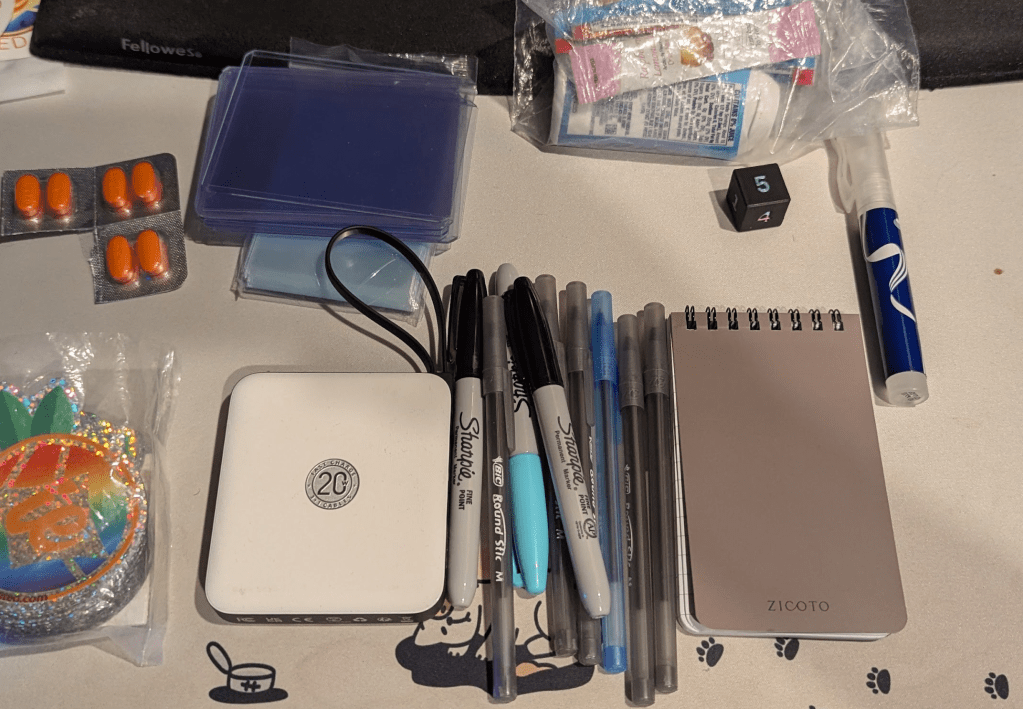
    My bag has stickers, tylenol, sleeves/toploaders, water flavoring, battery, pens/markers, notebook, end of round die, and hand sanitizer!
  • Soon I will be working with a LOT of judges at DLC Richmond and one of my main goals is to get them into areas or teams that they want to learn or can grow from. My goal in this post is to discuss some of the teams and strategies we use with them.

    From what I have seen, there are a few key teams that are generally incorporated for large events:

    • Deck Checks
    • Coverage/Features
    • Floor
    • Logistics
    • Paper
    • End of Round
    • Stage
    • Scheduled Side Events
    • On Demand Events

    Deck Checks
    Self explanatory, but this team’s main goal is to verify that deck lists have been submitted correctly. They also do checks through out the event to ensure that players have the correct decks with them and also that none of their cards/sleeves have become marked during play. They strategically swoop in for mid round checks but ensure swiftness on their checks so that the event doesn’t have long turn over times.

    Coverage/Features
    This team works directly with the production team and has to balance in a different world that exists within the main event. They watch the games closely and ensure the players are following the needs of the production. This team is critical as they are the team that must catch errors and correct them before the thousands of viewers start chatting about it on Twitch.

    Floor
    Floor team is the bread and butter of the event space. This team works with different leads and has to be flexible as the event moves around. They are responsible to ensure that there is enough coverage in every zone so that players feel that there are judges around to help and that judge calls can be answered swiftly.

    Logistics
    Logistics team is just that. They help with the logistics of certain aspects of the event. Be it handling strategies for passing out promos or fixing pairings to helping other teams find times to take breaks through the day. While the floor team covers the area for the players, this team covers the area for the judges.

    Paper
    Ravensburger Playhub will be the most utilized tool for players over the weekend but players don’t have access to it all the time, they’re trying to conserve battery life on their phones, or their friends need to find their friends. Paper team ensures that paper pairings are posted swiftly and also taken down accordingly. They help get the round started.

    End of Round
    Let’s face it, a lot of players complain about just how long the turn over time is from when we announce “Players! That is time in the round!” to “Pairings for the next round have been posted!” The end of round team is critical to keeping that time low. They assign judges to watch matches that are at the time limit and remind players that just because the play time is over, it doesn’t mean you have infinite amount of time in the 5 remaining turns. They also hunt for missing match records and get that info to the score keepers so that those players can report their match!

    Stage
    Stage team is a customer service facing team that helps cut down the amount of traffic our scorekeepers receive. Scorekeepers are constantly working on the next issue to ensure the event runs smoothly and stage helps filter out the critical things to allow scorekeepers to do their work. They answer questions or find answers for players so that players feel heard and can get back to playing as soon as possible.

    Scheduled Side Events
    The main or large events are just one part of the Disney Lorcana Challenge experience. Attendees or players that opt out of the main event will have tons of various side events they can play to earn more promos or cool playmats or swag. Scheduled Side events are the offerings that players can schedule around or build towards and there is always something running or coming up through the event. Judges here are wearing many hats to ensure their events run smooth and staffed.

    On Demand Events
    Sometimes players want bite sized chunks or an activity that they can just hop into. On Demand Events are just that and it is a constant rotation of helping players and working around the event space. This area is for managing chaos and thriving in logistics.

    If you are reading this as I am working towards assigning judges in roles at Richmond, whatever team you end up on, I hope you enjoy or learn from. Every team is key to the success of the event. And if you want to have a small say in where you might be, please check the Pastimes discord for Richmond and fill out the preference form I made 🙂


    Not every team will be listed here or even created for Richmond. Other events have other needs or combine or rename things but the general notion of those teams exist in every event you will be at. I hope this preview into the ethos of judging at large events helps!